
Oman new 1-rial polymer commemorative banknote
Oman new 1-rial polymer commemorative banknote
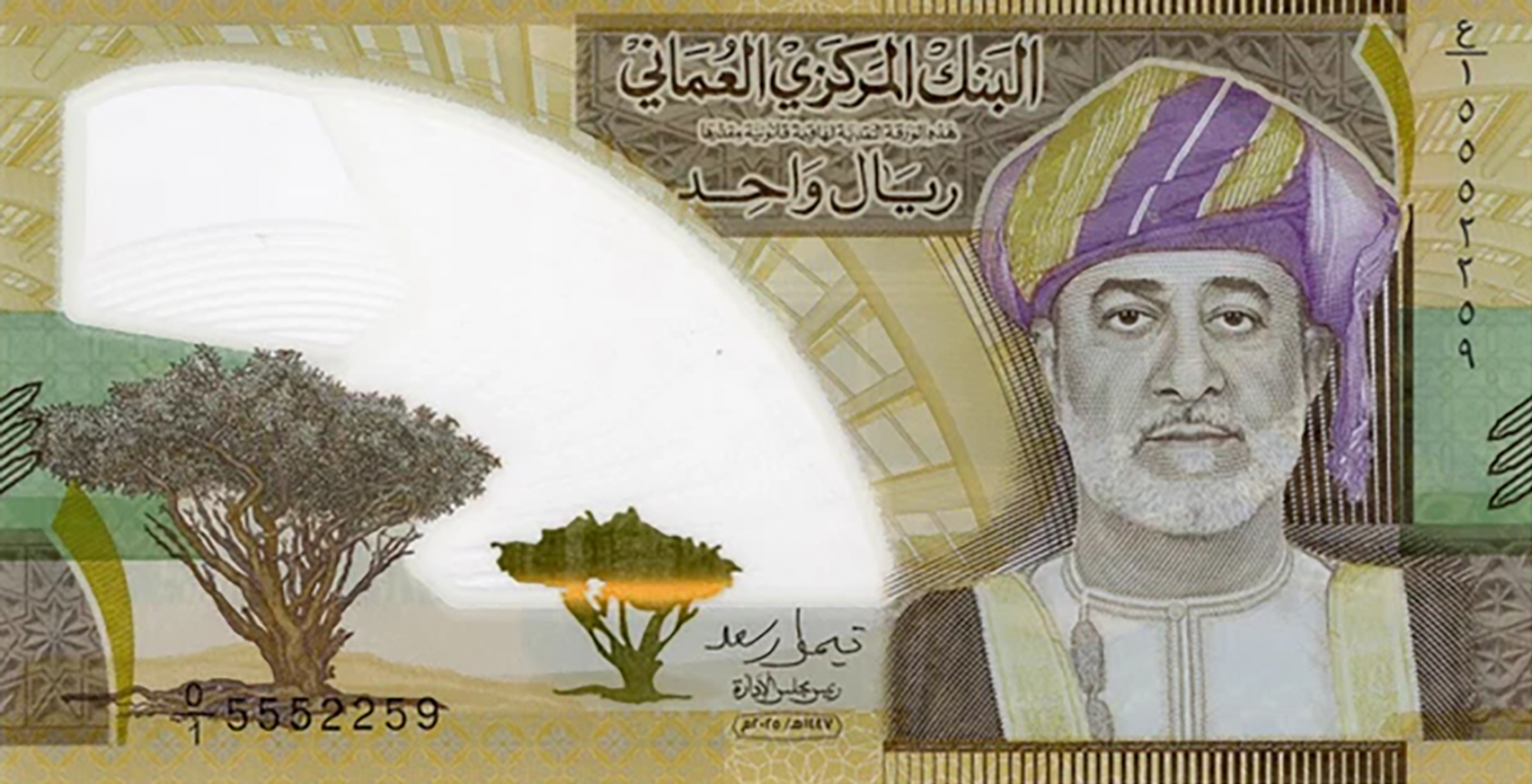
The Sultanate of Oman has officially confirmed the introduction of a new 1-rial polymer commemorative banknote (catalog reference B245a), marking a historic milestone in the evolution of Omani currency. Announced on 20 December 2025, the note entered circulation on 11 January 2026, becoming the first polymer banknote ever issued by Oman. Rather than replacing existing notes, this commemorative issue circulates in parallel with earlier cotton-based banknotes, retaining full legal tender status for all transactions nationwide.
Issued by the Central Bank of Oman, the new 1-rial polymer note reflects Oman’s strategy of combining innovation in currency technology with a strong emphasis on national identity and heritage. The adoption of polymer as a substrate introduces greater durability, resistance to moisture and tearing, and enhanced security possibilities compared with traditional paper notes. The polymer used is Guardian, produced by the global security printer Giesecke+Devrient, which also handled the printing of the note.
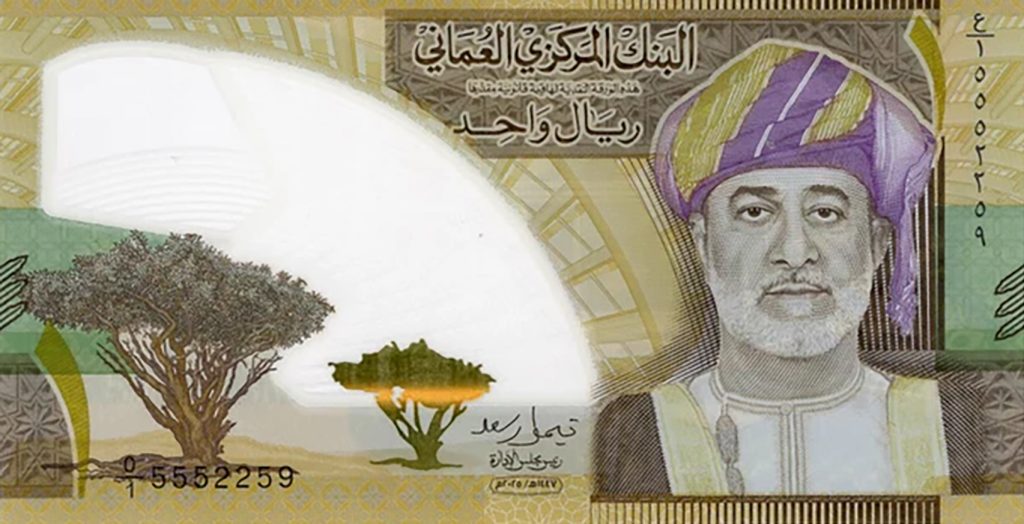
Measuring 145 × 76 mm, the banknote features a carefully curated color palette of brown, green, and purple, creating both visual distinction and symbolic depth. The front side, presented primarily in Arabic, centers on themes of leadership, environment, and cultural continuity. A prominent portrait of Sultan Haitham bin Tariq anchors the design, reinforcing the note’s role as a modern yet tradition-rooted national symbol. Alongside the portrait appears the frankincense tree, a timeless emblem of Oman’s historical role in global trade. This motif is rendered using optically variable ink (OVI), allowing the image to shift color when viewed from different angles.
One of the most striking design elements on the front is the large transparent polymer window, shaped as arched windows inspired by the Oman Botanic Garden. Occupying a substantial portion of the banknote, this clear window not only enhances visual appeal but also serves as a key security feature, difficult to replicate and immediately recognizable to the public.
The reverse side, printed primarily in English, highlights Oman’s forward-looking development and economic diversification. Featured prominently are Duqm Port and the Duqm Refinery, both symbols of Oman’s strategic industrial expansion and maritime connectivity. Complementing these modern landmarks is the Sayyid Tarik bin Taimour Cultural Complex, representing Oman’s investment in culture, education, and national memory. The arched window motif of the Oman Botanic Garden reappears on the back, creating visual continuity across both sides of the note.
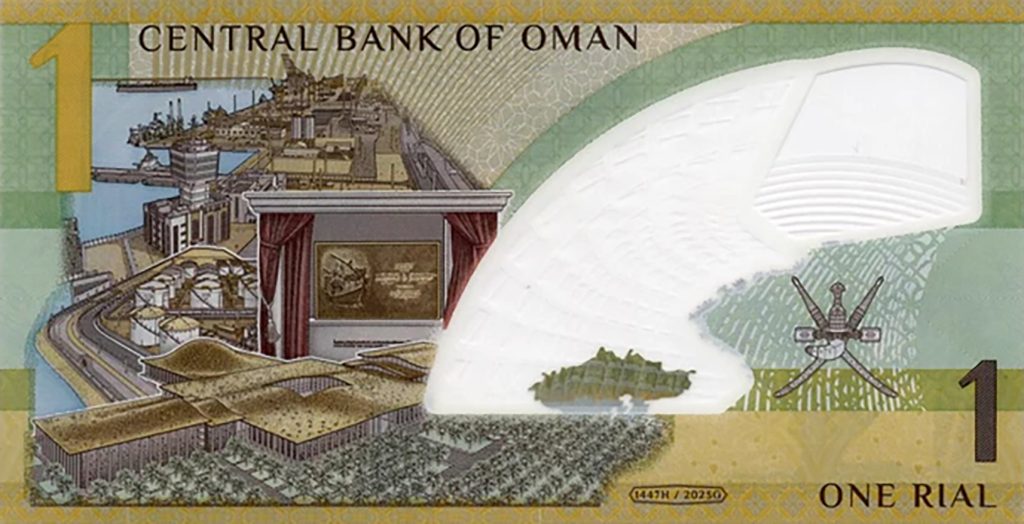
Also on the reverse is Oman’s coat of arms, featuring the iconic crossed swords and khanjar (dagger), a centuries-old national symbol of sovereignty and identity. An additional layer of sophistication is provided by iridescent ink forming a subtle Central Bank of Oman pattern, visible under changing light conditions and further strengthening the note’s security profile.
Unlike many traditional banknotes, the 1-rial polymer commemorative note does not include a security thread, relying instead on advanced polymer features such as the transparent window, OVI elements, and iridescent inks. The watermark (shadow image) has not been publicly specified, consistent with the fact that polymer notes typically depend less on classic paper-based watermarks and more on integrated optical features.