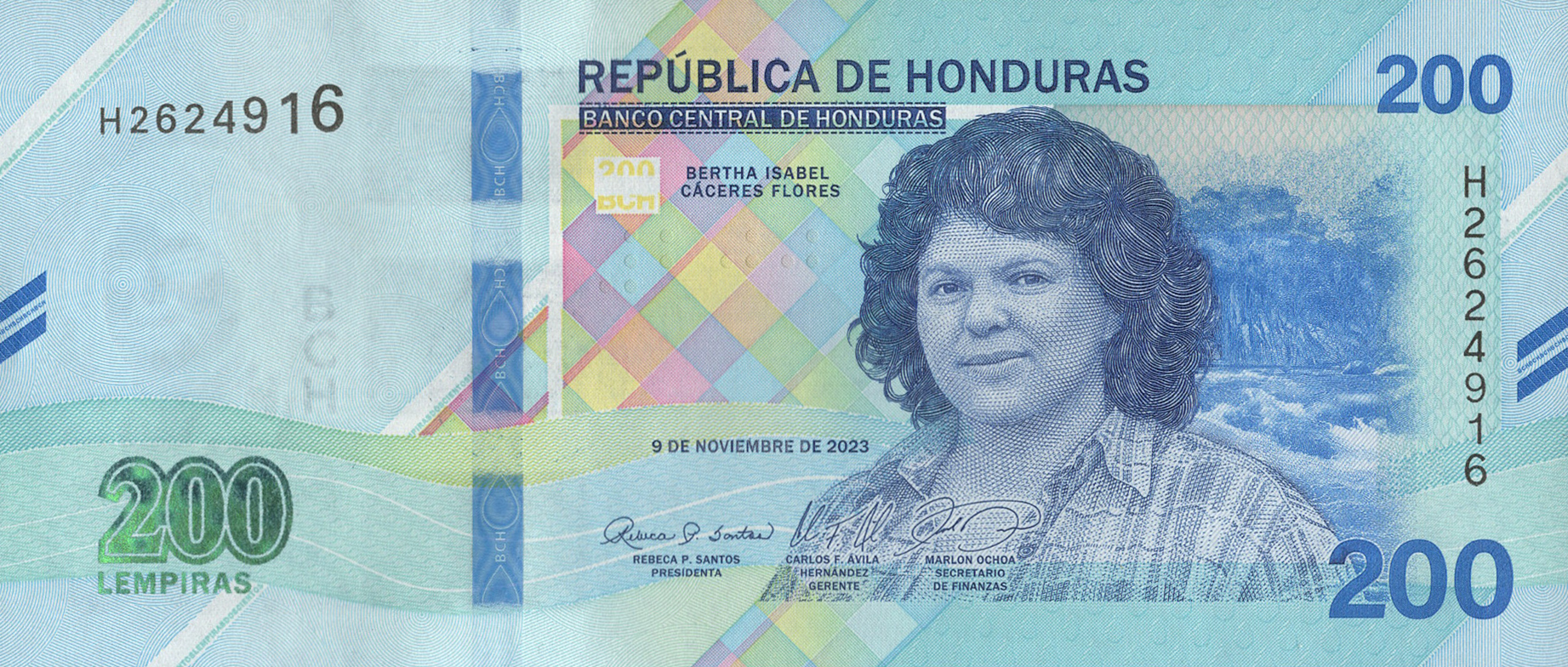
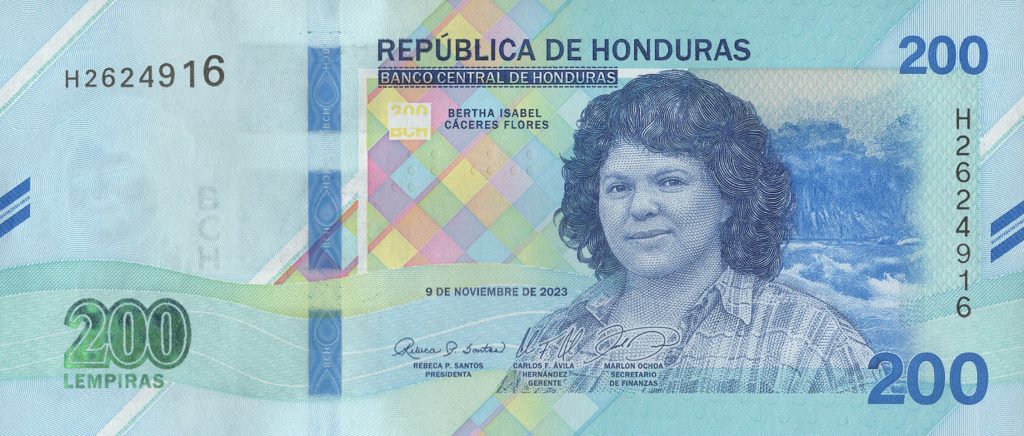
The front of the banknote presents a finely engraved portrait of Bertha Cáceres, rendered in blue tones that convey dignity and calm authority. Behind her, a multicolored geometric pattern inspired by traditional Lenca loom weaving reflects her Indigenous heritage and the cultural continuity of the Lenca people. The Gualcarque River and surrounding trees appear in the background, referencing the river Cáceres defended throughout her life as a sacred natural resource threatened by exploitation. The denomination “200 Lempiras” appears using SPARK ink and as a registration device, enhancing both visual impact and security.
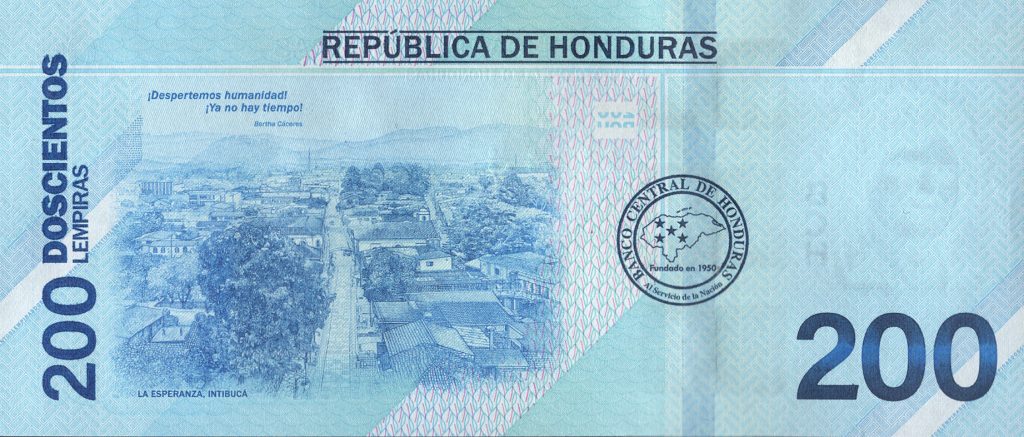
On the reverse, the design shifts to a broader social and geographic narrative. An aerial view of La Esperanza, Intibucá, the birthplace of Bertha Cáceres, situates her story firmly within Honduran territory and community life. Prominently featured is her powerful quote, “¡Despertemos humanidad! ¡Ya no hay tiempo!” translated as “Let us awaken humanity! There is no more time!” This message transforms the banknote from a monetary instrument into a call for collective responsibility and urgency in the face of environmental and social crises. The official seal of the Banco Central de Honduras reinforces the note’s authority and commemorative status.
Technically, the banknote reflects modern banknote production standards. Printed by Crane Currency in Malta, it measures 156 by 67 millimeters and is produced on high-quality paper. A green-to-blue windowed security thread with demetalized “BCH” lettering runs through the note, while the watermark features a portrait of Bertha Cáceres alongside the electrotype “BCH.” These elements ensure strong protection against counterfeiting while maintaining aesthetic coherence with the overall design.
The note carries the issue date “9 de noviembre de 2023” and bears the signatures Santos, Ávila, and Ochoa, corresponding to senior Honduran financial authorities. With prefix H and a total print run of 20,000,000 notes, it balances commemorative significance with practical circulation needs. Although dated 2023, the official introduction into circulation is scheduled for January 20, 2026, allowing time for public education and institutional preparation.
Beyond its physical attributes, the 200-lempira Bertha Cáceres note holds deep symbolic meaning. Bertha Cáceres was internationally recognized for her defense of Indigenous land rights and environmental justice, and her legacy resonates far beyond Honduras. By placing her image and words on a widely used banknote, Honduras formally integrates values of environmental stewardship, Indigenous dignity, and women’s leadership into everyday economic life.
In doing so, this banknote redefines what national currency can represent. It is not only a medium of exchange, but also a statement of collective values, historical recognition, and moral direction. The 200-lempira Bertha Cáceres commemorative stands as a landmark issue in Honduran numismatics and a visible reminder that economic systems, culture, and conscience are inseparably linked.
For collectors, historians, and the general public alike, the note is expected to become one of the most discussed Honduran issues of the decade. Its layered symbolism, advanced security features, and strong narrative coherence align Honduras with a global trend of commemorative banknotes that honor social leaders rather than abstract allegories. At the same time, its large print run ensures accessibility, allowing ordinary citizens to encounter and reflect on Bertha Cáceres’ legacy in daily transactions. As such, the banknote functions simultaneously as currency, memorial, educational tool, and ethical statement, reinforcing the idea that national identity is shaped not only by power and economics, but also by courage, memory, and the protection of life itself.
It signals a future where Honduran currency reflects conscience, inclusion, and respect for people, land, and history collectively nationally.