

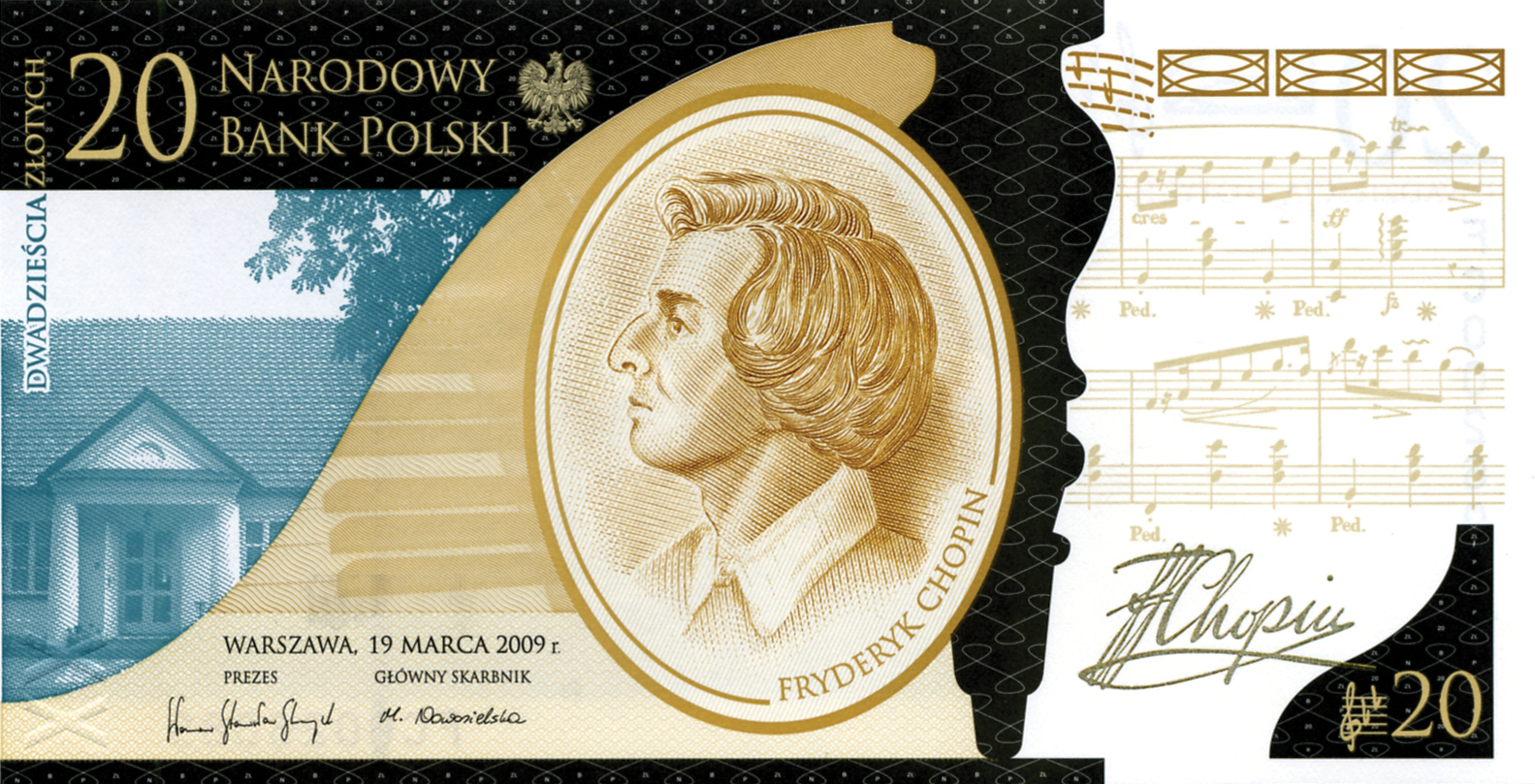
Poland 20 Złoty Chopin Commemorative Banknote (2010): Music, Memory, and National Identity
In 2010, Poland marked a milestone of exceptional cultural importance—the 200th anniversary of the birth of Frédéric François Chopin—with a special commemorative banknote that united music, history, and national identity in a single work of art. Issued by the National Bank of Poland, the 20-złoty Chopin commemorative note stands as one of the most refined modern European banknotes, celebrated equally by numismatists, musicians, and cultural historians.
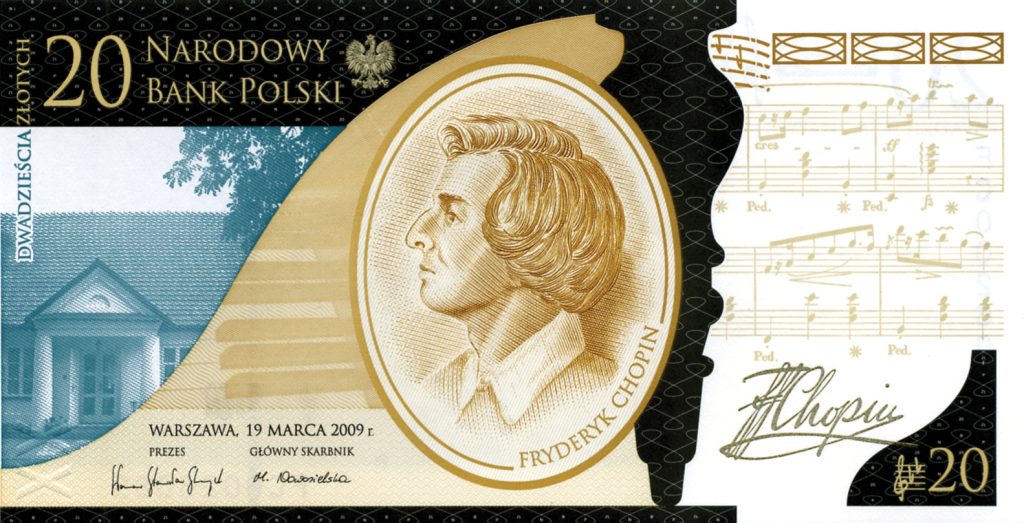
Released for sale on 22 February 2010, the note was produced in a limited quantity of 120,000 pieces, each packaged in an official folder and sold at a premium price of 50 złotych. Although denominated as legal tender, the issue was clearly designed as a commemorative collectible, reflecting the extraordinary status of Chopin not only as Poland’s most famous composer but also as a global symbol of Romantic music.
Historical Context: Chopin at 200
Born in 1810, Frédéric François Chopin occupies a singular place in Polish and European cultural history. Though he spent much of his adult life in France, Chopin’s music remained deeply rooted in Polish traditions, rhythms, and emotional memory. Genres such as the mazurka and polonaise—both present in this banknote’s iconography—became musical expressions of national identity at a time when Poland itself was absent from the political map of Europe.
The year 2010 was officially declared the “Year of Chopin” in Poland, with concerts, exhibitions, academic conferences, and international cultural events held worldwide. The commemorative banknote formed part of this broader national and international tribute, transforming Chopin’s legacy into a tangible object of everyday culture.
Obverse: The Composer as a National Icon
The obverse of the 20-złoty note presents a finely engraved portrait of Frédéric Chopin, shown in profile with a contemplative expression. Rather than depicting a dramatic or romanticized figure, the design emphasizes intellectual depth and introspection—qualities closely associated with Chopin’s music.
Behind the portrait appears the birthplace mansion in Żelazowa Wola, the rural estate where Chopin was born and which today serves as a national museum and pilgrimage site for music lovers. This architectural motif grounds the composer firmly in Polish soil, reinforcing the idea that his genius emerged from a specific cultural and geographical landscape.
Also featured on the obverse are fragments of the score of the Mazurka in B minor, Op. 7, a genre inseparable from Polish folk tradition. Chopin’s flowing signature appears prominently, bridging music and identity, while the Polish coat of arms with the crowned eagle asserts state authority and cultural continuity.
Reverse: Music in Motion and the Polish Landscape
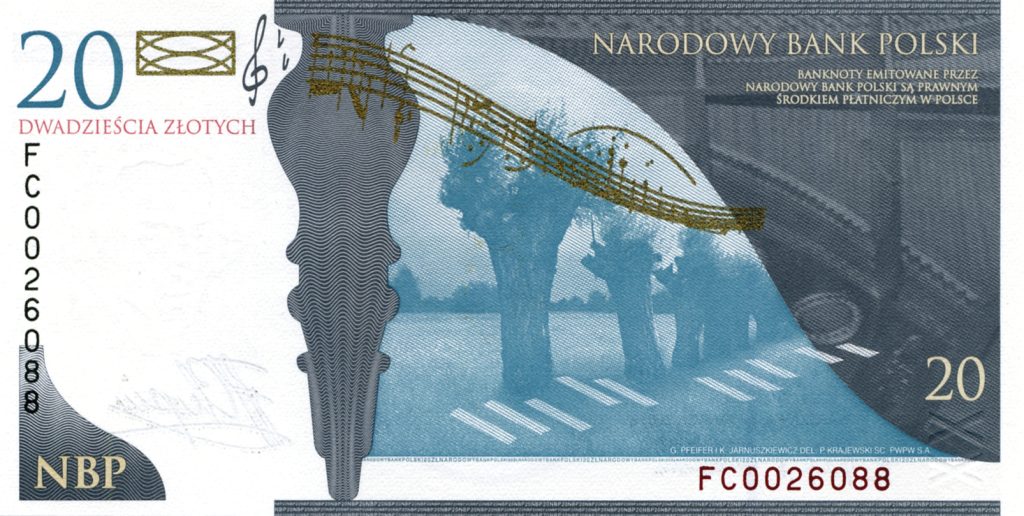
The reverse design shifts from biography to atmosphere and emotion. It features Masovian willow trees, a recurring symbol in Polish art and literature, long associated with melancholy, nostalgia, and the rural heartland. These willows echo the emotional tone of Chopin’s music, particularly his slower, more introspective works.
Interwoven with the landscape is the musical score of the Étude in F minor, Op. 10, one of Chopin’s technically demanding and emotionally charged compositions. Rather than serving as mere decoration, the notation functions as a visual metaphor for motion, rhythm, and creative intensity. Music becomes landscape, and landscape becomes music—an elegant synthesis of art forms.
Together, the obverse and reverse tell a coherent story: Chopin as a historical figure, a national symbol, and a universal musical voice.
Design, Printing, and Security Features
The note was printed by PWPW S.A., Poland’s state security printer, using high-quality paper rather than polymer. Measuring 138 × 69 mm, the banknote employs a restrained yet sophisticated palette of black, tan, and blue, aligning with its classical theme.
Security features include a solid security thread with microprinted “20 ZŁ”, detailed intaglio printing, and a watermark depicting Frédéric Chopin himself. These elements ensure both authenticity and aesthetic harmony, integrating security seamlessly into the artistic design.
Cultural and Numismatic Significance
The 2010 Chopin commemorative 20-złoty note is remarkable for how successfully it balances commemoration and circulation. While legal tender, its limited issue and premium packaging positioned it as a cultural artifact rather than a transactional object. In this sense, it resembles a printed monument—portable, accessible, and enduring.
More broadly, the note reflects how modern states use currency as a medium of cultural storytelling. By choosing Chopin, Poland reaffirmed music as a cornerstone of national identity, equal in importance to political history or military achievement. The banknote does not celebrate conquest or power; instead, it honors creativity, emotion, and intellectual legacy.
For collectors, the note is prized for its artistic refinement and historical context. For musicians, it represents formal recognition of Chopin’s lasting influence. And for Poland, it serves as a quiet yet powerful statement: that culture, memory, and art remain central to the nation’s self-understanding.
In essence, the Poland 20-złoty Chopin commemorative banknote of 2010 is far more than a celebration of a birthday. It is a carefully composed tribute—like one of Chopin’s own works—where every line, symbol, and motif contributes to a harmonious expression of Polish cultural identity.