
The 2010 Papua New Guinea 2 Kina Polymer Commemorative Banknote:
Material Innovation, Cultural Memory, and the 35th Anniversary of Independence
1. Introduction and Context
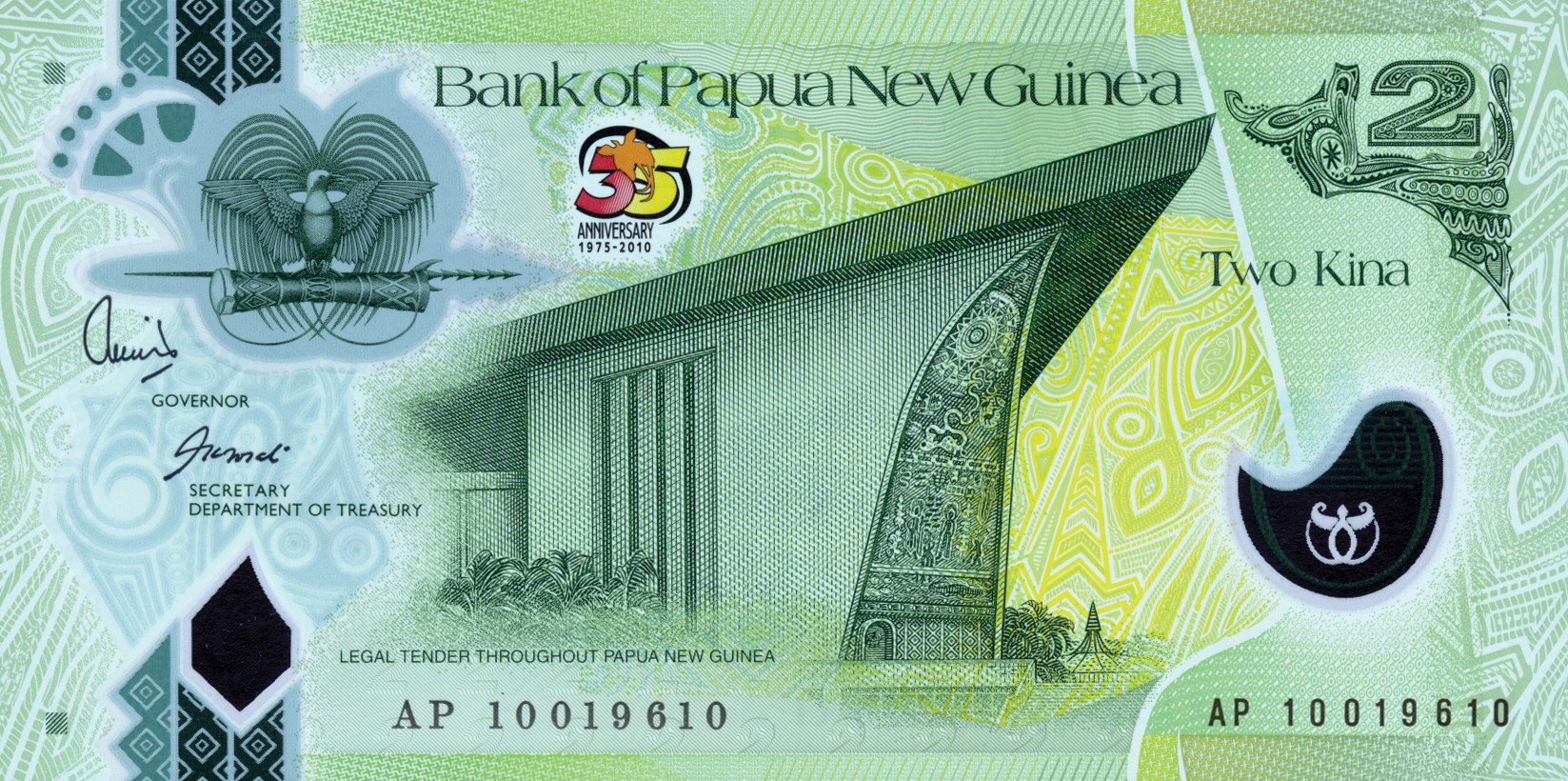
In September 2010, the Bank of Papua New Guinea (BPNG) introduced a new series of polymer banknotes to commemorate the 35th anniversary of Papua New Guinea’s independence from Australia (1975–2010). Among these issues, the 2 Kina polymer commemorative note occupies a distinctive position, both as a low-denomination daily-use note and as a carefully curated symbol of national identity. While the overall designs remain closely aligned with preceding circulating notes, the addition of a commemorative anniversary logo and the adoption of polymer substrate mark this issue as a deliberate fusion of continuity and modernization.
Dated (20)10 and signed by Governor Leonard Wilson Kamit and Secretary of Treasury Simon Tosali, the note reflects Papua New Guinea’s evolving approach to currency as both an economic instrument and a cultural artifact.
2. Physical Description and Visual Composition
The 2 Kina commemorative note is predominantly rendered in soft green and yellow tones, harmonized with intricate geometric background patterns inspired by traditional Melanesian art. On the obverse, the Bank of Papua New Guinea title is prominently displayed, accompanied by the national emblem featuring the Bird of Paradise, a long-standing symbol of sovereignty, freedom, and unity across Papua New Guinea’s diverse cultural landscape.
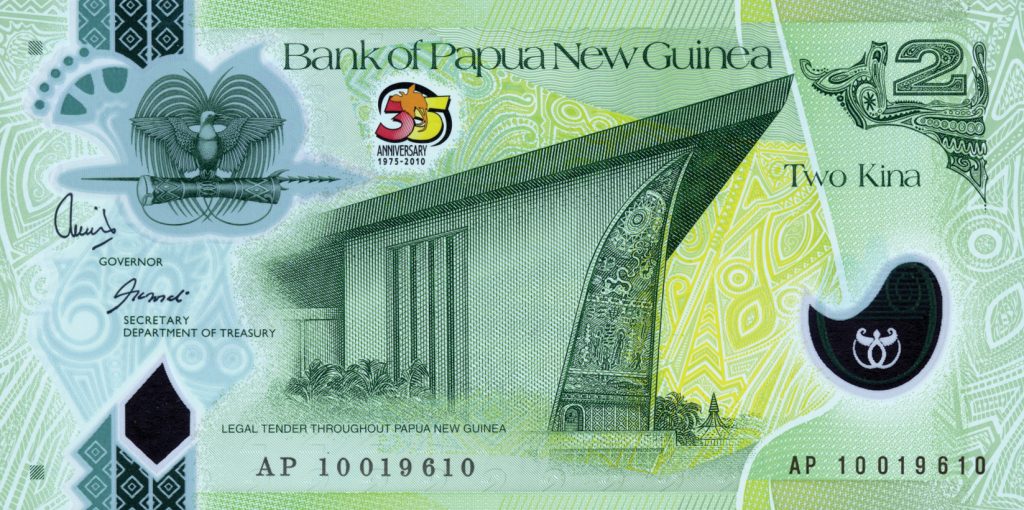
A notable architectural element dominates the obverse composition: a stylized modernist building, widely interpreted as symbolizing state institutions, governance, and national progress. This architectural motif contrasts intentionally with the organic forms and traditional patterns embedded in the background, visually expressing the dialogue between tradition and modern nationhood.
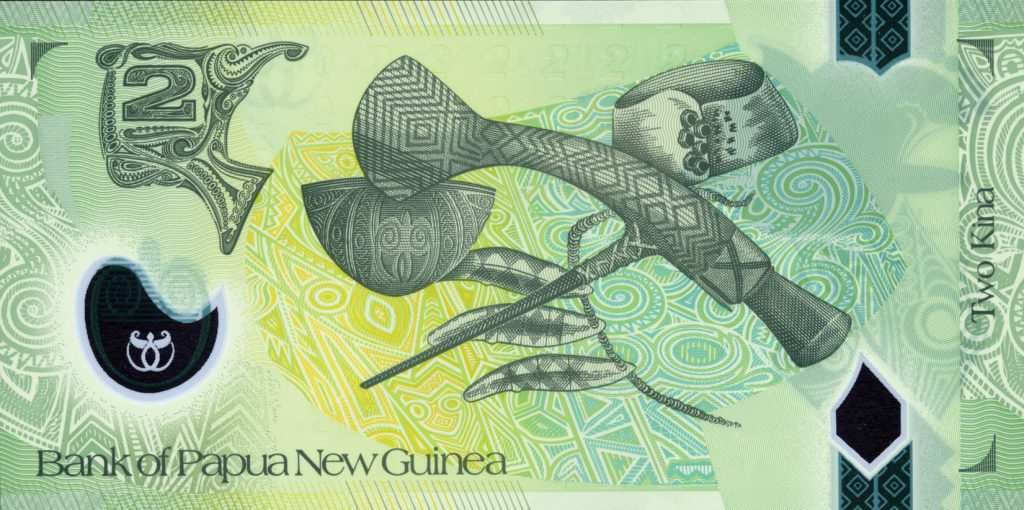
The reverse side presents an assemblage of traditional ceremonial objects, including carved wooden implements and ritual tools associated with indigenous cultural practices. These objects are not identified with a single ethnic group; rather, they serve as a pan-cultural representation of Papua New Guinea’s extraordinary ethnographic diversity, encompassing over 800 linguistic communities.
The “35th Anniversary 1975–2010” logo, placed discreetly yet clearly on the obverse, anchors the note firmly in its commemorative purpose without overwhelming its everyday usability.
3. Printing Technology and Polymer Innovation
One of the most significant aspects of this issue lies in its polymer substrate, produced using advanced security printing technology. The notes were manufactured using polymer film supplied through processes associated with modern banknote production standards, offering major advantages over traditional paper.
Key technological features include:
-
Transparent windows integrated into the polymer, incorporating national motifs and micro-elements that are difficult to replicate.
-
Raised intaglio printing, providing tactile feedback for authenticity verification.
-
Optically variable elements, subtly changing appearance under different angles of light.
-
Micro-text and fine line engraving, visible only under magnification.
-
Improved durability, particularly important in Papua New Guinea’s humid tropical climate.
Polymer banknotes significantly extend circulation life, reduce replacement costs, and enhance resistance to counterfeiting—concerns explicitly acknowledged by the BPNG in its modernization strategy.
4. Historical Significance and Independence Narrative
Papua New Guinea achieved independence from Australia on 16 September 1975, following decades of colonial administration and gradual political transition. The period between independence and the 2010 anniversary was marked by complex challenges: nation-building across extreme cultural diversity, economic development, and political consolidation.
The 35th anniversary represents neither a founding moment nor a centennial milestone, but rather a reflective interval—long enough for institutional memory to mature, yet recent enough for lived experience to remain vivid. The commemorative note thus functions as a medium of collective remembrance, quietly reinforcing historical consciousness in daily transactions.
Unlike portrait-based commemoratives common in other countries, Papua New Guinea’s approach avoids depictions of individual leaders. This choice underscores a national philosophy that privileges collective identity over personal authority, aligning with Melanesian social values.
5. Symbolic Meaning and Artistic Interpretation
From an artistic perspective, the 2 Kina commemorative note embodies a layered narrative. The juxtaposition of modern architecture with traditional artifacts is not decorative but conceptual. It asserts that modern statehood does not erase indigenous heritage; rather, it is constructed upon it.
The abstract patterns flowing across the note echo traditional body art, weaving, and carving styles, translated into a contemporary graphic language. The polymer medium itself becomes part of the symbolism: transparent yet resilient, flexible yet strong—qualities metaphorically aligned with the nation’s aspirations.
The absence of dramatic imagery or overt political slogans reinforces the note’s scholarly restraint. It communicates stability, continuity, and quiet confidence rather than triumphalism.
6. Numismatic Context and Collectability
In addition to circulation issues, the BPNG released a numismatic album set containing all six denominations with low and matching serial numbers, catering specifically to collectors and institutions. This dual-track approach—circulation and collectible—reflects a growing global recognition of currency as cultural heritage.
For numismatists, the 2 Kina polymer commemorative note is significant not for rarity but for contextual value. It represents a transitional moment in Papua New Guinea’s monetary history: the normalization of polymer technology, the maturation of post-independence identity, and the institutionalization of commemorative design within everyday currency.
7. Conclusion
The 2010 Papua New Guinea 2 Kina polymer commemorative banknote is a carefully balanced artifact of material science, national history, and visual culture. It does not seek spectacle, but rather longevity—both physically and symbolically. Through its design, technology, and commemorative intent, the note encapsulates Papua New Guinea’s journey from colonial administration to a self-defined, modern nation rooted in ancestral heritage.
For researchers and collectors alike, it stands as a compelling example of how banknotes can function simultaneously as tools of commerce, carriers of memory, and canvases of national identity.