


The 2010 Nicaragua 50-Córdoba Polymer Commemorative:
Vertical Design, Institutional Memory, and the Aesthetics of Modern Central Banking
On 16 September 2010, the Banco Central de Nicaragua (BCN) issued a polymer 50-córdoba banknote to commemorate the 50th anniversary of the founding of the central bank (1960–2010). This note represents a landmark in Nicaragua’s monetary history, not only because of its commemorative function, but also due to its innovative vertical orientation, polymer substrate, and carefully curated symbolic program. With a total print run of approximately six million notes, the issue was designed to circulate alongside the preceding standard 50-córdoba note, thereby bridging everyday monetary use and institutional commemoration.
Physical Description and Visual Composition
The commemorative note measures 141 × 67 mm and is the first vertically oriented banknote ever issued by the Banco Central de Nicaragua, marking a clear departure from the traditional horizontal layout used in earlier series. The vertical format is not merely a stylistic novelty; it fundamentally reshapes how imagery, text, and security elements interact on the surface of the note.

The obverse (front) prominently features a detailed engraving of the original headquarters of the Banco Central de Nicaragua, labeled “Edificio Antiguo BCN.” The building is rendered in a restrained architectural style, emphasizing solidity, rational geometry, and institutional permanence—qualities closely associated with central banking. Above and around the building, the note incorporates the official seal of the central bank, bearing the inscription “Fundado en 1960”, explicitly anchoring the design to the anniversary theme.
The denomination “50” appears in multiple locations, rendered in muted yet sophisticated tones of violet, lavender, and gray, harmonizing with the overall chromatic palette. Floral motifs—stylized tropical blossoms—float across the design, introducing organic forms that soften the architectural rigidity and reference Nicaragua’s natural environment.
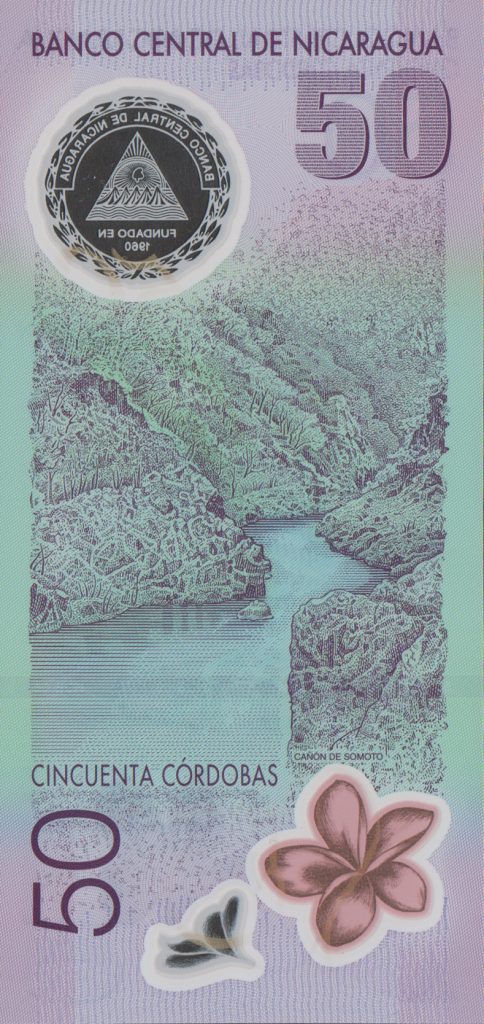
The reverse depicts the Somoto Canyon (Cañón de Somoto), one of Nicaragua’s most significant natural landmarks. The canyon scene is engraved with fine linear detail, showing steep rock walls, flowing water, and dense vegetation. This imagery contrasts deliberately with the obverse: where the front emphasizes institutional history and human construction, the reverse celebrates geological time, natural heritage, and national landscape.
Printing Technology and Security Features
The note is printed on a polymer substrate, reflecting Nicaragua’s adoption of modern banknote technology in the early 21st century. Polymer offers significant advantages over traditional cotton paper, including increased durability, resistance to moisture and dirt, and enhanced compatibility with advanced security features.
Key security elements include transparent windows, a defining characteristic of polymer notes, integrated seamlessly into the vertical layout. These windows contain embossed and printed elements that are difficult to counterfeit and easy for the public to verify. Microtext, precision line engraving, and color-shifting inks further enhance the note’s security profile.
The polymer substrate also enables a higher level of graphic clarity, allowing both the architectural rendering on the obverse and the canyon landscape on the reverse to achieve exceptional sharpness and depth. From a numismatic perspective, this issue exemplifies how security engineering and artistic design can coexist without visual compromise.
Symbolic Meaning and Commemorative Intent
The thematic core of the note is institutional memory. By depicting the first headquarters of the central bank, the design honors the foundational moment of Nicaragua’s modern monetary authority in 1960. This choice emphasizes continuity, professionalism, and the role of the central bank as a stabilizing force in the nation’s economic life.
The inclusion of Somoto Canyon on the reverse broadens the narrative beyond the institution itself. It situates the central bank within the wider context of the nation it serves, linking economic governance with territorial identity and natural heritage. Together, the two sides articulate a balanced vision: state institutions grounded in history and legitimacy, operating within a diverse and enduring national landscape.
The floral motifs scattered across both sides further reinforce themes of renewal and growth, subtly suggesting the bank’s role in fostering sustainable economic development.
Historical Context
The Banco Central de Nicaragua was established in 1960, during a period of institutional modernization and economic restructuring in the country. Over the subsequent decades, the bank navigated periods of political change, economic instability, and monetary reform. By 2010, the issuance of a polymer commemorative note symbolized both a retrospective acknowledgment of this complex history and a forward-looking embrace of modern currency technology.
The decision to allow the commemorative note to circulate alongside standard issues is particularly noteworthy. Rather than isolating the anniversary note as a purely numismatic product, the BCN embedded it into everyday monetary life, ensuring that institutional history would be encountered not only by collectors but by the general public.
Numismatic Significance
For collectors, the 2010 50-córdoba polymer note holds special significance as a triple milestone: the first vertical note of Nicaragua, the first BCN anniversary commemorative on polymer, and a rare example of a circulating institutional jubilee issue. Its moderate print run ensures accessibility while preserving long-term collectability.
In sum, this banknote stands as a refined synthesis of design innovation, technological advancement, and historical narrative. It is not merely a medium of exchange, but a carefully constructed artifact of national memory—one that rewards close study and secures its place in the modern numismatic canon of Central America.