

The 2010 Bank of Jamaica 50-Dollar Commemorative Banknote:
The 2010 commemorative 50-dollar banknote of Jamaica was issued on 15 November 2010 by the Bank of Jamaica to mark the 50th anniversary of the establishment of the central bank (1960–2010). Although the formal anniversary celebrations were scheduled to begin in May 2011, the early release of this note reflects the symbolic importance attributed to the institution’s half-century role in shaping Jamaica’s monetary sovereignty. The note represents a carefully balanced synthesis of continuity and commemoration, remaining fully legal tender while introducing subtle but meaningful visual and textual modifications.
Physical Description and Artistic Composition
The commemorative note retains the standard format and dimensions of Jamaica’s circulating $50 denomination, ensuring immediate recognizability and seamless integration into everyday commerce. The obverse is dominated by a portrait of Samuel Sharpe, one of Jamaica’s seven National Heroes and a central figure in the 1831–1832 Baptist War, also known as the Christmas Rebellion. Sharpe’s likeness, rendered in finely modulated intaglio engraving, conveys solemn dignity and moral resolve, reinforcing his symbolic role as an emblem of resistance, emancipation, and national consciousness.
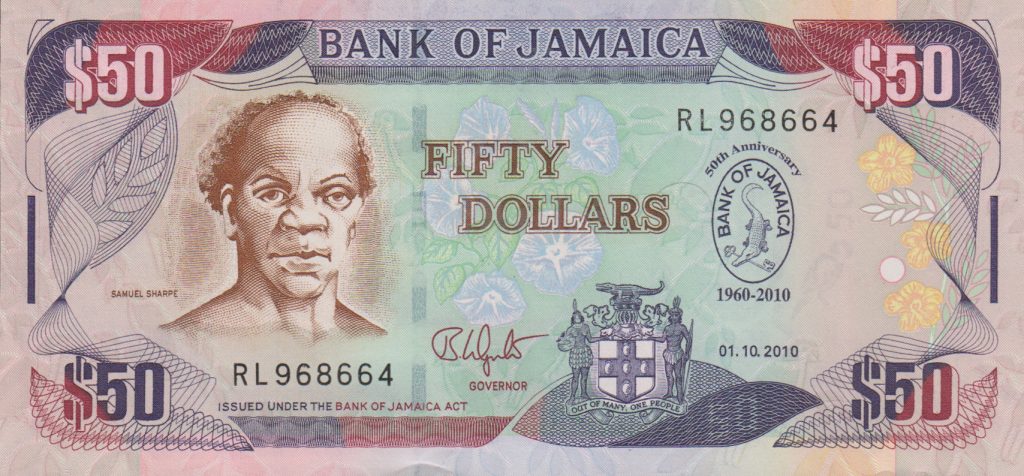
Above and around the central portrait, the traditional layout is preserved, including denomination numerals, serial numbers, and ornamental line work. The principal commemorative intervention is the Bank of Jamaica logo printed in blue, accompanied by the inscription “50th Anniversary” and the dates “1960–2010”. These additions are deliberately restrained in scale and placement, ensuring that the commemorative message complements rather than disrupts the established visual hierarchy of the note.
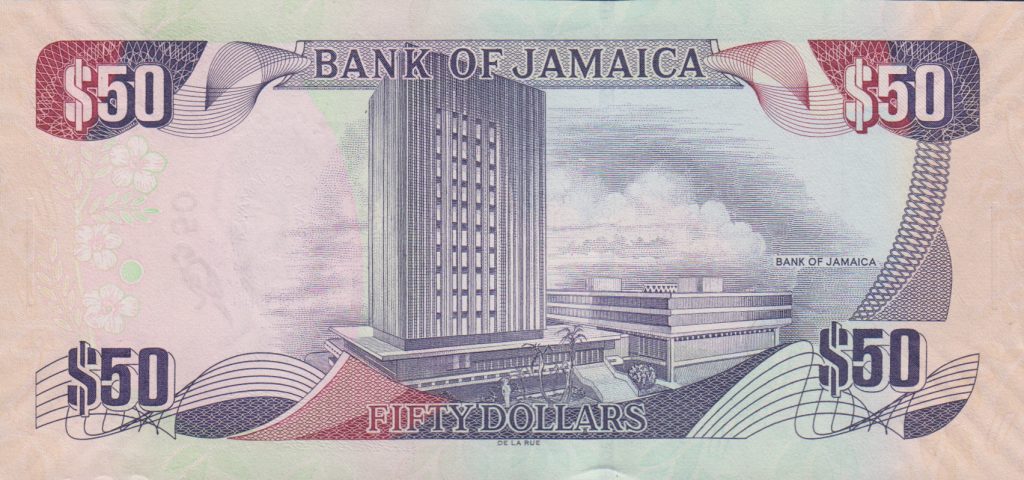
The reverse presents a significant thematic departure from the standard $50 note. Replacing the familiar Doctors Cave Beach scene is a detailed vignette of the Bank of Jamaica headquarters at Nethersole Place, depicted with architectural clarity and gravitas. The building is framed against a medallion-style background of morning glory blossoms, a motif that introduces both decorative elegance and symbolic resonance.
Printing Technology and Security Features
From a technical standpoint, the commemorative $50 note employs the same printing technologies and security features as the regular circulating issue, underscoring its status as a functional banknote rather than a purely collector-oriented artifact. The note was produced using a combination of intaglio printing, offset lithography, and letterpress techniques, resulting in crisp line definition, tactile depth, and layered visual complexity.
Key security elements include microprinted text, finely interlaced guilloché patterns, latent images, and precisely registered serial numbers. The intaglio portrait of Samuel Sharpe provides both tactile verification and aesthetic authority, while the multi-tonal background patterns complicate reproduction by unauthorized means. Importantly, the Bank of Jamaica opted not to introduce experimental security innovations for this commemorative issue, reflecting an institutional preference for proven reliability and public familiarity.
Symbolic Meaning and Institutional Identity
The symbolic language of the 2010 commemorative note operates on multiple levels. At the most immediate level, it celebrates five decades of central banking in Jamaica, marking the evolution of the Bank of Jamaica from its establishment in 1960—two years prior to political independence in 1962—into a cornerstone of national economic governance.
The continued presence of Samuel Sharpe on the obverse reinforces a broader narrative of freedom and self-determination. By juxtaposing Sharpe’s portrait with the headquarters of the central bank, the note visually links Jamaica’s struggle for emancipation with its modern pursuit of monetary autonomy and institutional stability. This pairing transforms the banknote into a symbolic bridge between moral liberation and economic self-governance.
The morning glory blossoms on the reverse further enrich this symbolism. As flowers associated with renewal, transience, and cyclical growth, they subtly evoke the idea of institutional continuity through changing economic conditions. Their medallion-like arrangement frames the headquarters building almost as an emblem or seal, reinforcing the bank’s role as guardian of the nation’s financial system.
Historical Context: The Bank of Jamaica and Nation-Building
The Bank of Jamaica was founded in 1960 during a period of constitutional transition, as the island moved toward independence from British colonial rule. Its establishment signaled a decisive step toward economic self-management, enabling Jamaica to regulate currency issuance, oversee monetary policy, and stabilize the financial system in a post-colonial context.
By 2010, the Bank of Jamaica had navigated decades of economic fluctuation, including inflationary pressures, debt restructuring, and financial sector reform. The commemorative note thus functions not merely as a celebration of longevity, but as a material acknowledgment of institutional resilience amid global and domestic challenges.
Numismatic Context and Collector Significance
From a numismatic perspective, the 2010 $50 commemorative note occupies an intermediate category between ordinary circulation currency and limited-edition collector issues. Both the commemorative and standard versions circulate in parallel, a practice that reflects inclusivity rather than exclusivity. The note’s appeal to collectors lies not in rarity, but in contextual and documentary value.
For researchers, the note provides insight into how post-colonial states use currency design to articulate institutional memory and national narrative. For collectors, it represents a tangible marker of the Bank of Jamaica’s first half-century, distinguished by subtle design changes rather than dramatic visual reinvention.
Conclusion
The 2010 Bank of Jamaica 50-dollar commemorative banknote stands as a refined example of how a central bank can employ restraint, symbolism, and technical continuity to commemorate institutional history. Through its thoughtful integration of portraiture, architecture, floral motifs, and established security technology, the note transcends its everyday monetary function. It becomes a compact historical document—one that embodies Jamaica’s journey from colonial administration to sovereign financial stewardship, preserved in the quiet artistry of paper money.