
The 50th Anniversary Banknotes of the Guinean Franc
The 50th Anniversary Banknotes of the Guinean Franc
Monetary Memory, Visual Sovereignty, and Post-Colonial Identity
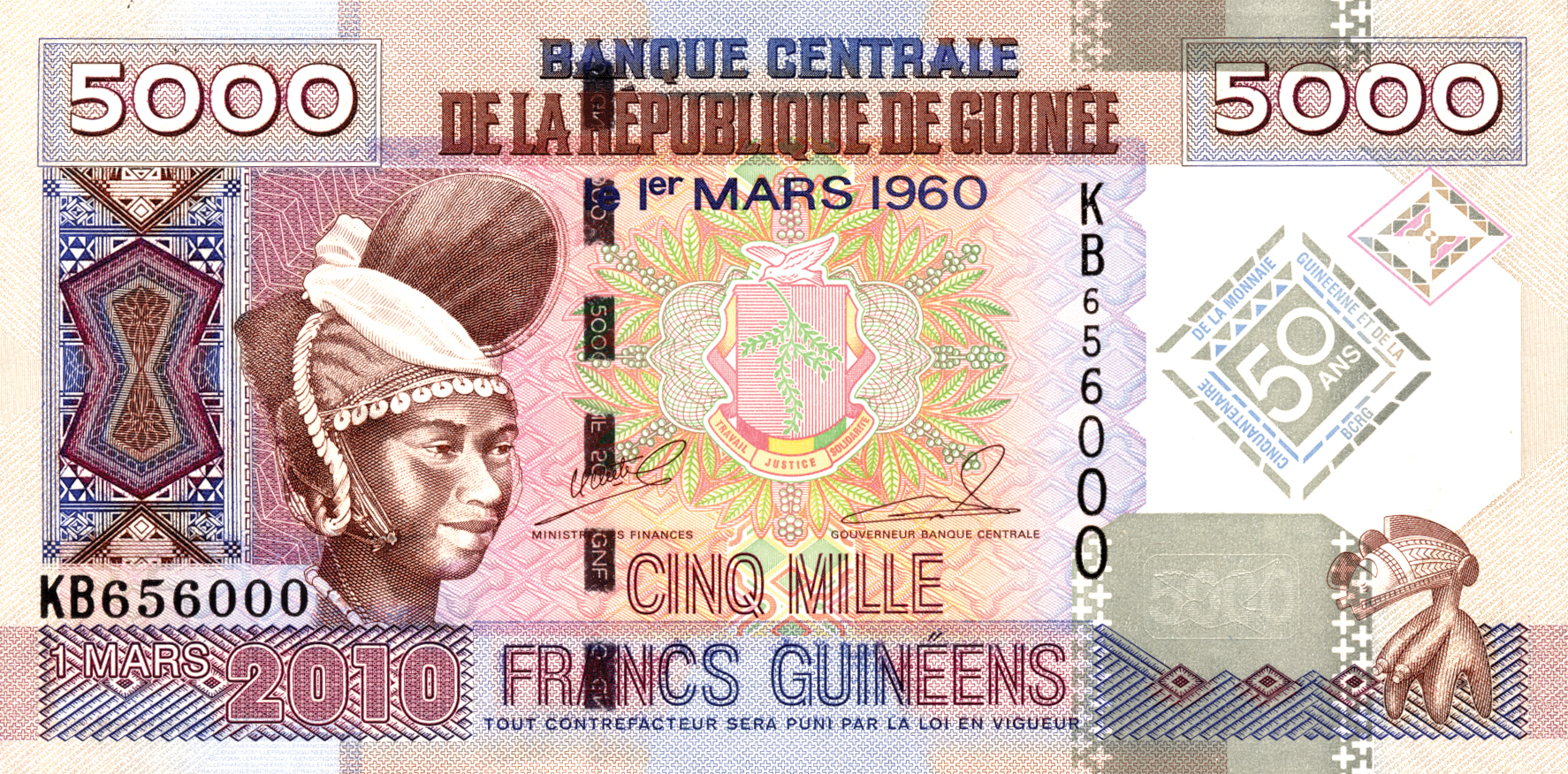
In November 2010, the Banque Centrale de la République de Guinée (BCRG) introduced a new series of banknotes in denominations of 1,000, 5,000, and 10,000 Guinean francs to commemorate the 50th anniversary of the national currency, first issued on 1 March 1960. Far from being routine replacements, these notes constitute a carefully constructed visual and technical statement about Guinea’s political history, cultural identity, and aspirations for monetary sovereignty in the post-colonial era.
Physical Description and Visual Composition
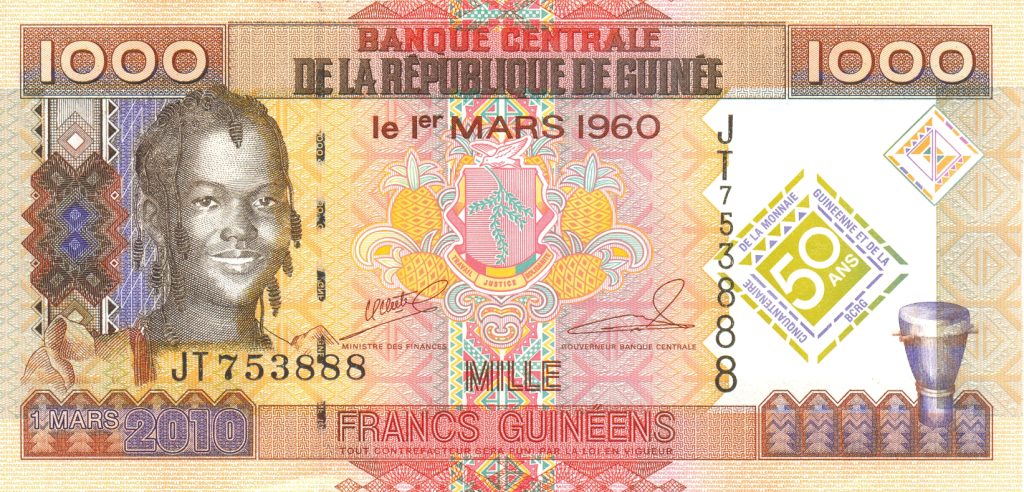
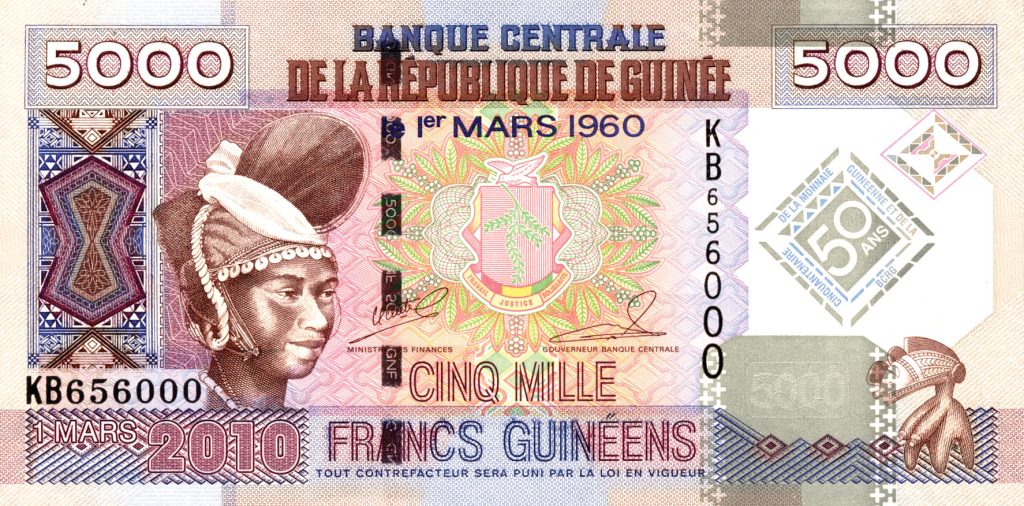
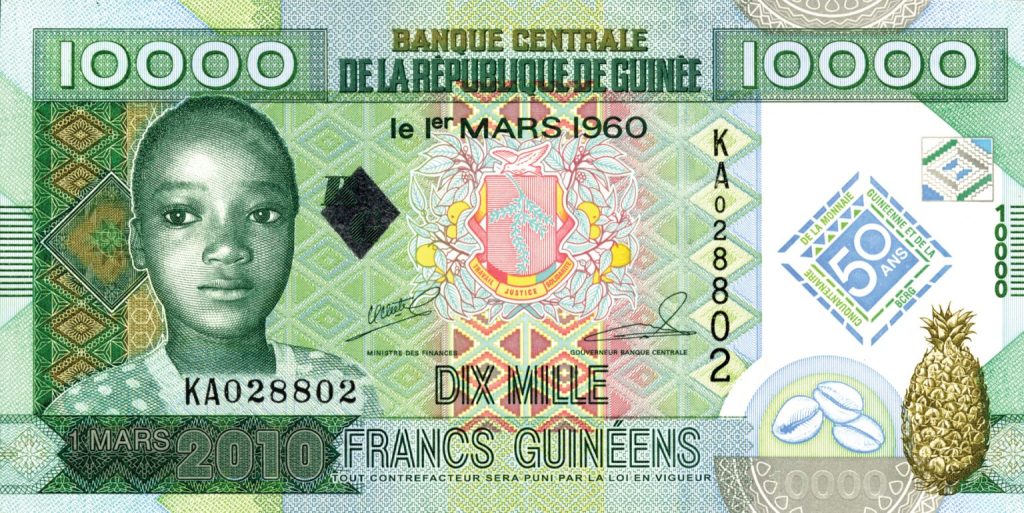
The anniversary series maintains the traditional horizontal format but introduces a refined visual language characterized by dense geometric ornamentation, multicolor guilloché backgrounds, and balanced asymmetry. Each denomination carries a distinct chromatic identity—earthy ochres for the 1,000 franc, warmer reds and purples for the 5,000 franc, and cooler greens for the 10,000 franc—allowing rapid denomination recognition while reinforcing symbolic differentiation.
On the obverse, all three notes prominently display the inscription “Banque Centrale de la République de Guinée” and the historic date “le 1er mars 1960,” anchoring the series directly to the birth of the Guinean franc. Portraits of Guinean citizens—women and youth rendered in finely engraved realism—replace the more abstract or colonial-era motifs of earlier emissions. These faces are not identified individuals but archetypes, representing continuity, dignity, and demographic vitality.
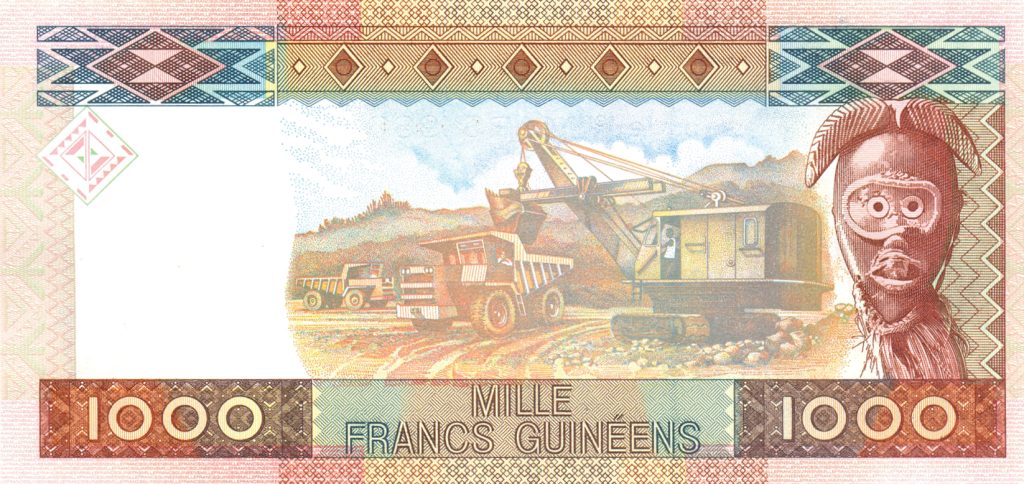
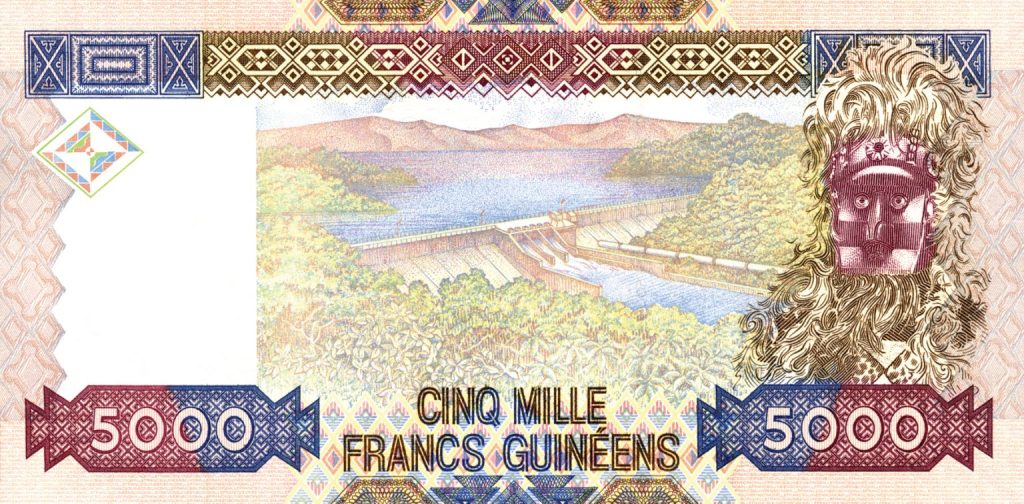
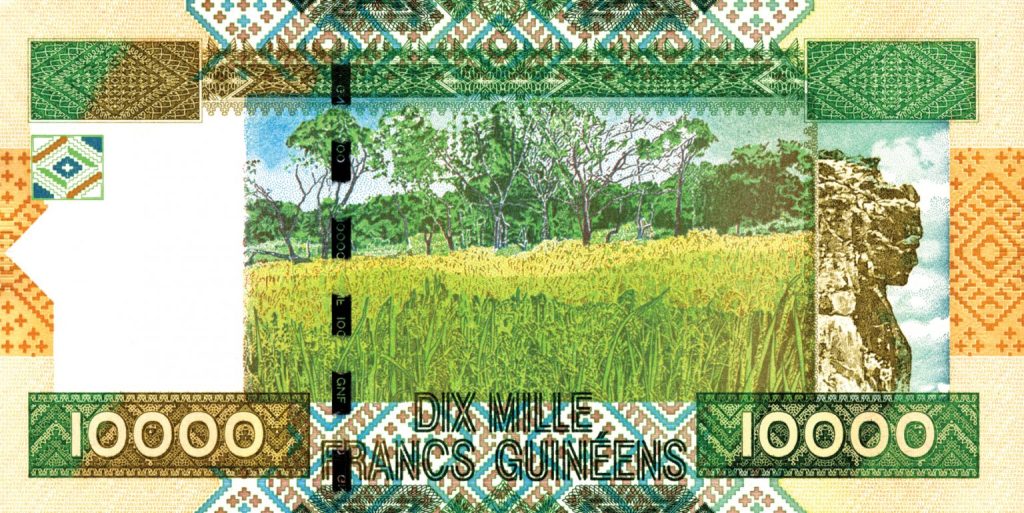
The reverse designs emphasize national productivity and cultural heritage. Scenes include agricultural landscapes, hydroelectric infrastructure, and mining machinery—visual shorthand for Guinea’s natural wealth and development ambitions—alongside traditional masks and ornamental motifs. The integration of human presence with industrial and environmental imagery underscores a narrative of progress rooted in indigenous identity rather than external models.
Printing Technology and Security Architecture
Technologically, the 2010 anniversary series marked a substantial advancement for Guinean currency. The notes are printed on high-quality banknote paper with enhanced durability varnish, increasing resistance to humidity, abrasion, and handling—an important consideration in Guinea’s tropical climate.
Security features were significantly upgraded. Intaglio printing is used extensively for portraits, numerals, and key inscriptions, producing tactile relief detectable by touch. Windowed and solid security threads, some embedded and others partially exposed, provide machine-readable and visual authentication. Microtext, latent images, and complex line structures are integrated into the guilloché fields, resisting both digital reproduction and traditional counterfeiting techniques.
A particularly notable element is the 50th anniversary logo positioned in the watermark area. This emblem, visible in transmitted light, functions as both a commemorative marker and a security device, merging symbolic celebration with technical necessity. The watermark itself varies by denomination, reinforcing differentiation while maintaining design cohesion across the series.
Symbolism and Interpretive Meaning
Symbolically, these notes operate on multiple levels. The repeated invocation of 1960 is not merely chronological; it recalls Guinea’s early and assertive rejection of continued colonial dependence. The currency anniversary thus becomes a proxy for national autonomy, financial self-determination, and institutional continuity.
The portrayal of ordinary Guineans—especially women and youth—signals a shift away from elite or singular political iconography toward a collective national subject. This democratic visual philosophy contrasts sharply with earlier African banknotes that often emphasized leaders or abstract allegories inherited from European design traditions.
The industrial and agricultural reverses articulate an aspirational vision of Guinea’s economy: one in which natural resources, infrastructure, and human labor coexist in a balanced national project. The imagery does not deny hardship or underdevelopment but frames them within a forward-looking narrative of capacity and resilience.
Historical Context of the Guinean Franc
The Guinean franc was introduced in 1960, two years after independence, replacing the CFA franc system that linked former French colonies to Paris-based monetary control. Guinea’s decision to establish an independent currency was politically bold and economically risky, resulting in immediate external pressure and internal challenges.
Over the subsequent decades, the franc underwent multiple redesigns and reforms, reflecting shifts in governance, ideology, and economic strategy. The 2010 anniversary series stands apart as a moment of consolidation rather than rupture—a retrospective affirmation that the currency, despite instability and inflation, remains a core institution of statehood.
Broader Political and Cultural Context
The unveiling of the anniversary notes in November 2010 coincided with a period of political transition and cautious optimism in Guinea. The central bank’s emphasis on improved security and durability reflects both practical anti-counterfeiting concerns and a symbolic assertion of institutional competence.
Culturally, the series participates in a broader African trend of reclaiming banknote design as a site of historical narration and artistic expression. These notes are not merely transactional tools; they function as circulating documents of memory, identity, and sovereignty, handled daily by millions yet encoded with layers of meaning accessible to the attentive observer.
Conclusion
The 2010 Guinea 50th Anniversary banknotes represent a mature synthesis of art, technology, and national storytelling. Through sophisticated printing techniques, inclusive iconography, and historically grounded symbolism, the series transforms currency into a medium of collective remembrance. For collectors and researchers, these notes offer not only technical interest but also a compelling case study in how post-colonial states use money to articulate who they are, where they came from, and how they envision their future.