
A Dual Centennial in Paper: Mongolia’s 100,000-Tögrög Commemorative Banknote
The 100,000-tögrög commemorative banknote stands as one of the most symbolically layered and historically significant issues in modern Mongolian numismatics. Conceived to honor the centennial of the People’s Revolution of 1921, the note ultimately came to embody two intertwined milestones: the revolutionary transformation of the Mongolian state and the hundredth anniversary of the national currency itself, the tögrög, first introduced into circulation on 9 December 1925.
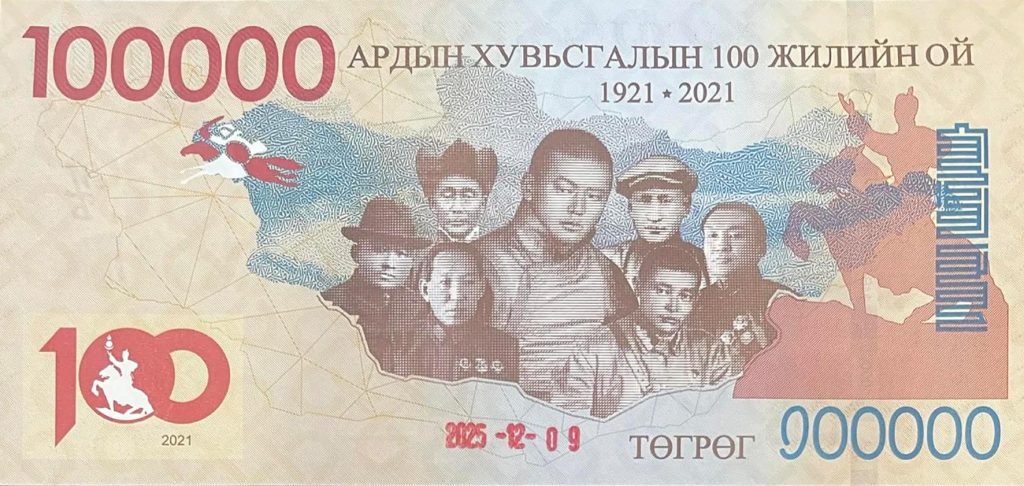
Although the design bears the year 2021 to mark the 100th anniversary of the People’s Revolution, its actual release was postponed until 2025. To reconcile this delay with its historical intent, the issued notes were overprinted in red on the lower center of the reverse with the date “2025-12-09,” explicitly commemorating the centenary of the tögrög. This dual dating makes the note a rare example of a single banknote memorializing two separate centennials within Mongolia’s modern national narrative.
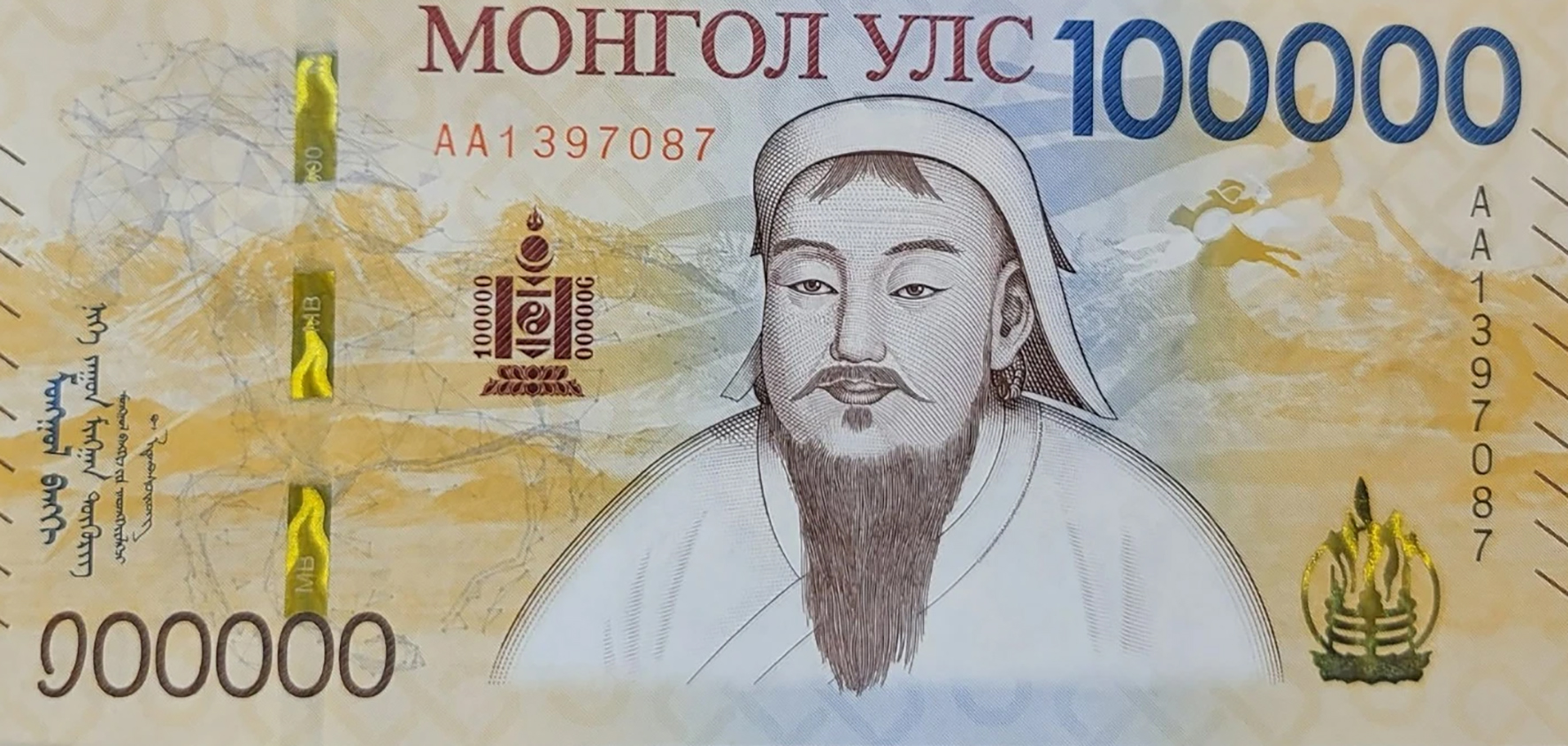
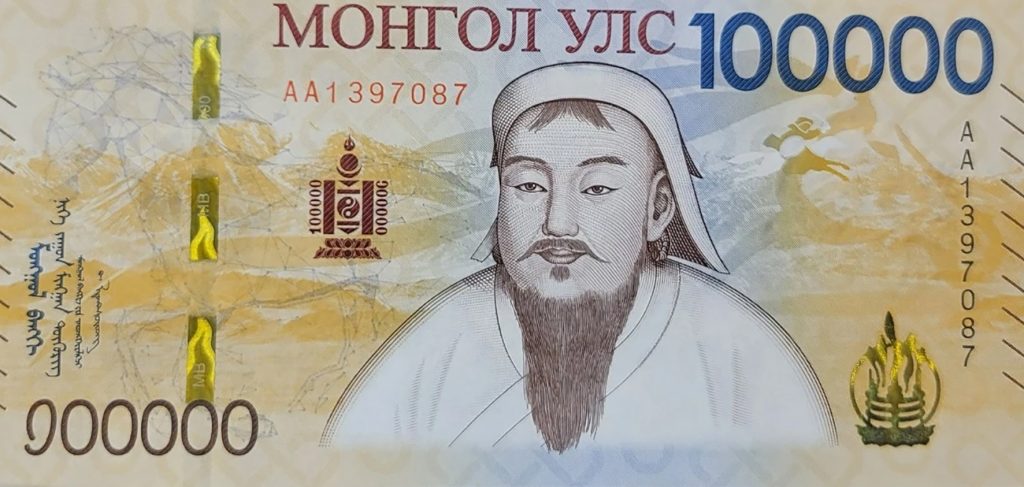
The obverse is dominated by a finely engraved portrait of Chinggis Khaan, whose image symbolizes unity, sovereignty, and the enduring legacy of the Mongolian state. Behind the portrait unfolds a stylized mountain range, evoking the vast steppe and sacred geography of Mongolia. A detailed map of the country reinforces territorial identity, while the Soyombo symbol—one of Mongolia’s most revered national emblems—anchors the design in cultural and spiritual continuity. A dynamic warrior on horseback appears as a registration device, echoing Mongolia’s nomadic heritage and martial tradition. Adding a modern security flourish, a flaming green-to-gold SPARK feature shifts color under light, blending symbolism with advanced anti-counterfeiting technology.
The reverse of the banknote deepens its historical focus. Centered against a patterned map of Mongolia is a powerful group portrait of the First Seven leaders of the People’s Revolution: Damdin Sükhbaatar, Dogsomyn Bodoo, Soliin Danzan, Dansranbileg Dogsom, Darzav Losol, Dambyn Chagdarjav, and Khorloo Choibalsan. Their collective depiction emphasizes revolutionary unity rather than individual dominance, reflecting the ideological foundations of the modern Mongolian state. A silhouetted warrior on horseback reappears, visually linking past heroism with revolutionary sacrifice and national rebirth.
From a technical standpoint, the banknote integrates a windowed security thread bearing demetalized “MB 100000” inscriptions, visible when held to the light. The watermark combines a portrait of Chinggis Khaan with an electrotype “МБ,” ensuring both visual elegance and robust protection against counterfeiting. Printed on paper rather than polymer, the note measures 150 by 72 millimeters, aligning with large-format commemorative issues intended to convey prestige and authority. The color palette—orange, brown, red, and blue—balances warmth and gravitas, reinforcing the ceremonial nature of the denomination.
The extraordinarily high face value of 100,000 tögrög places this issue firmly in the realm of commemorative and ceremonial currency rather than everyday circulation. It reflects inflationary realities while simultaneously asserting symbolic power: the note is meant to be seen, studied, and preserved as much as it is to be spent. Its unknown printer adds an element of mystery, further enhancing its appeal among collectors and scholars.
In sum, the 100,000-tögrög commemorative banknote is far more than a medium of exchange. It is a carefully constructed historical document, uniting Mongolia’s imperial legacy, revolutionary transformation, and monetary sovereignty into a single, visually compelling artifact. As such, it occupies a distinguished place in the story of Mongolia’s national identity and its evolving currency tradition.