
Bhutan New Commemorative 1,000-Ngultrum Note: A Symbolic Portrait of Kingship, Faith, and National Continuity
Reported for introduction in January 2026, Bhutan’s new commemorative 1,000-ngultrum banknote (B227a) represents a landmark issue in the modern currency history of the Himalayan kingdom. Printed on polymer (Safeguard) and produced by De La Rue, the note blends advanced security technology with deeply rooted Bhutanese symbolism. More than a high-denomination banknote, it functions as a carefully curated visual narrative of monarchy, spiritual authority, and historical continuity.
Basic characteristics and technical profile
The commemorative note measures 155 × 75 mm, making it slightly larger than Bhutan’s standard circulating issues and emphasizing its ceremonial nature. Its color palette—orange, brown, blue, and purple—creates a warm yet dignified aesthetic, evoking monastic murals, brocade textiles, and the dramatic Himalayan landscape. The substrate is polymer, signaling Bhutan’s gradual adoption of durable, environmentally resilient materials suited to mountainous climates and long circulation life.
Unlike many contemporary banknotes, this issue does not include a traditional security thread. Instead, its anti-counterfeiting strength is anchored in a prominent holographic security stripe, sophisticated watermarking, and the intrinsic complexity of polymer printing.
Obverse: the universal ruler and the founding monarch
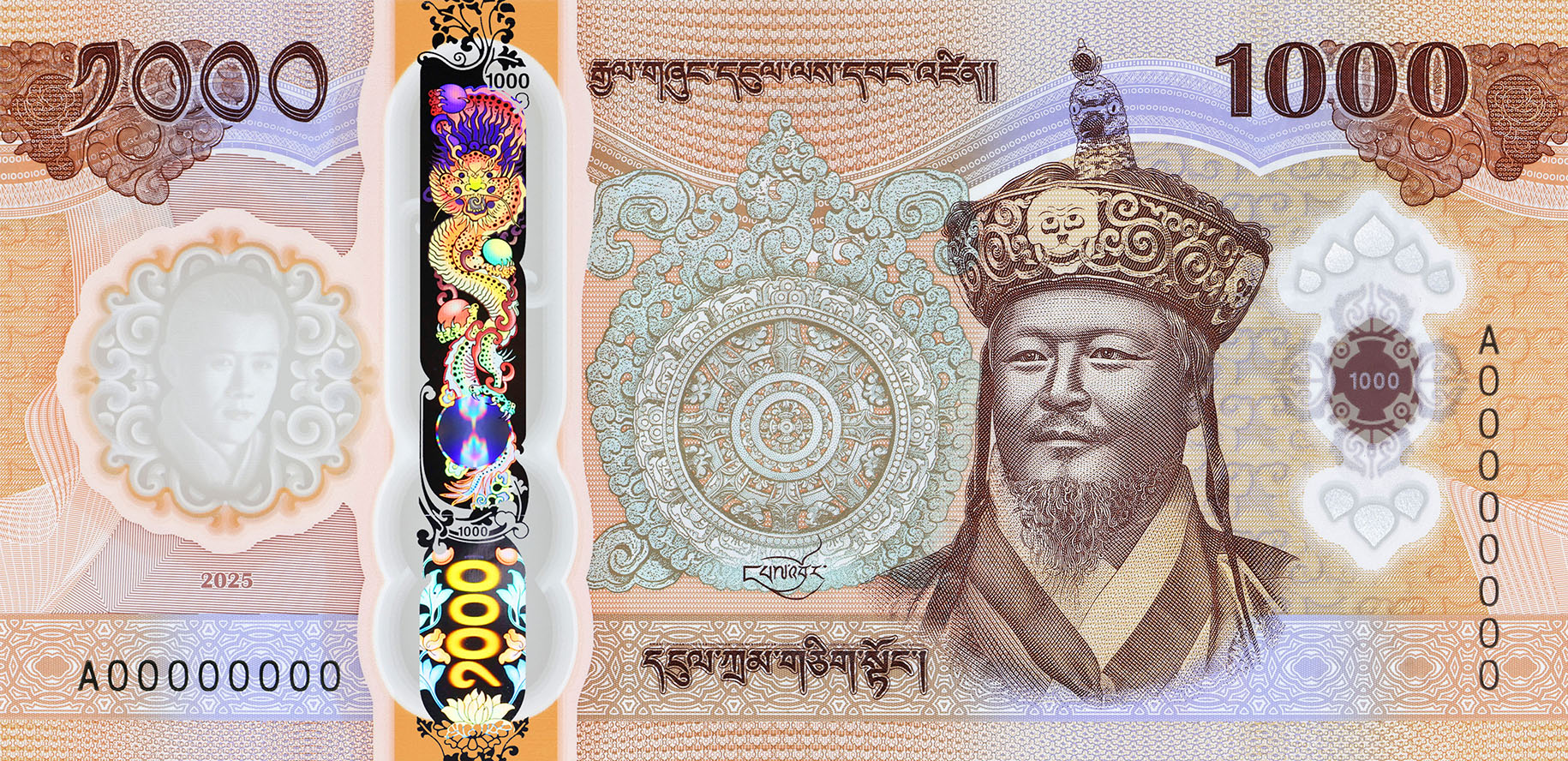
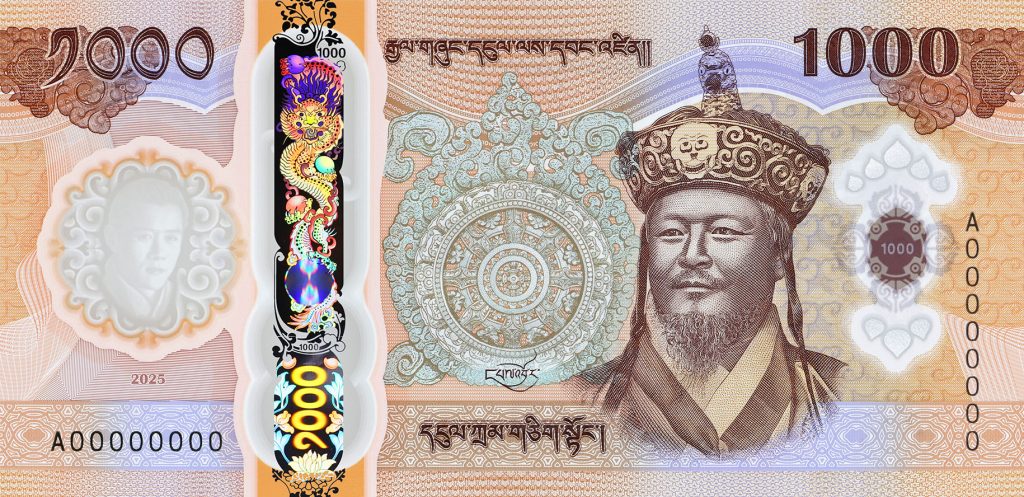
The front (obverse) is dominated by Dzongkha text and sacred iconography. At its center appears the Wheel of the Universal Ruler (Chakravartin)—a powerful Buddhist symbol representing righteous governance, moral authority, and harmony between temporal power and spiritual law. Its inclusion establishes the philosophical framework of the note: leadership is legitimate only when aligned with Dharma.
Anchoring this symbolism is the portrait of Ugyen Wangchuck, the first king of Bhutan and founder of the Wangchuck dynasty. He is shown wearing the Raven Crown, an emblem reserved exclusively for Bhutanese monarchs. The raven, associated with Mahakala—the protective deity of Bhutan—signifies divine guardianship over the nation and its kings. Through this imagery, the banknote links the modern Bhutanese state directly to its dynastic origins in 1907.
The obverse composition balances portraiture with sacred geometry. The Wheel motif radiates stability and cosmic order, while the restrained color gradients reinforce solemnity rather than spectacle. This is not a celebratory design in the festive sense; it is contemplative, ceremonial, and authoritative.

Reverse: dynasty, territory, and mythic guardianship
The reverse expands the narrative from kingship to place, lineage, and protection. Central to the composition is Tongsa Dzong, depicted with architectural precision. Historically the ancestral seat of the Wangchuck dynasty and the home of the Tongsa Penlop, this fortress-monastery represents the geopolitical heart of pre-modern Bhutan. From Tongsa Dzong, authority once radiated across eastern and western Bhutan, making it a powerful symbol of unity before the formal establishment of the monarchy.
Above the dzong appear dragons—the Druk, or Thunder Dragon, from which Bhutan derives its self-name Druk Yul (“Land of the Thunder Dragon”). These dragons embody sovereignty, natural power, and the protective spirit of the nation. Interwoven with them is the Garuda, a mythological bird-deity revered in both Buddhist and Hindu traditions, symbolizing swiftness, vigilance, and the triumph of wisdom over chaos.
Below, two great hornbills perch on a branch. Native to Bhutan’s forests, hornbills are ecological icons and cultural symbols of fidelity, abundance, and balance between humanity and nature. Their inclusion subtly reinforces Bhutan’s global identity as a nation guided by environmental stewardship and the philosophy of Gross National Happiness.
The reverse also features the seal of the state, grounding the spiritual and mythological imagery within the framework of modern governance and legal authority. Dzongkha and English text coexist, reflecting Bhutan’s dual orientation: deeply traditional yet outward-looking.
Security features and modern craftsmanship
The most visually striking security element is the holographic stripe, which depicts a dragon grasping jewels. This motif is rich in layered meaning: the dragon symbolizes the state, while the jewels represent wisdom, prosperity, and the protection of national treasures—both material and cultural. As the note is tilted, the hologram shifts dynamically, producing color and depth effects that are extremely difficult to replicate.
The watermark (shadow image) portrays Jigme Khesar Namgyel Wangchuck, the reigning monarch. This creates a subtle but powerful temporal dialogue: the first king on the printed surface and the fifth king embedded within the polymer structure. Together, they visually encode dynastic continuity across generations.
Meaning and significance
Taken as a whole, the commemorative 1,000-ngultrum note is a meditation on legitimacy, continuity, and harmony. Every element—from the Wheel of the Universal Ruler to Tongsa Dzong, from dragons to hornbills—serves a narrative function. The banknote asserts that Bhutan’s sovereignty flows not merely from political institutions, but from a moral and spiritual contract between ruler, land, and people.
For collectors, the note stands out as a highly symbolic polymer issue with restrained yet intricate design. For Bhutanese citizens, it reinforces a shared historical memory and national philosophy each time it changes hands. In an era when banknotes increasingly favor abstract or purely technological aesthetics, Bhutan’s 2026 commemorative 1,000-ngultrum note reaffirms the power of currency as cultural text—a small, durable canvas on which a nation tells its story.