Indonesia 50,000 Rupiah 1993 Commemorative Banknote: 25 Years of Development in Paper and Polymer
The Indonesia 50,000 Rupiah commemorative banknotes issued in 1993–1994 represent one of the most important and technically ambitious currency projects in the nation’s modern history. Released by Bank Indonesia, these notes were created to commemorate “25 Years of Development (1968–1993)”, a period associated with large-scale economic growth, infrastructure expansion, and modernization under President Soeharto.
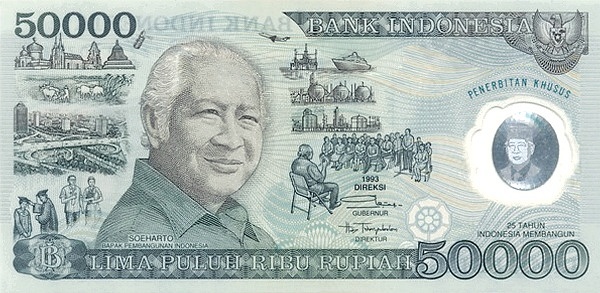
What makes this commemorative issue particularly distinctive is that it was produced in both polymer and paper versions, an unusual approach at the time. The polymer note, cataloged by collectors as P-134, was Indonesia’s first experiment with polymer banknote technology. Initially, only the ZZZ serial series was released in 1993, while other serials were held in reserve. These reserves were later put into circulation in 1998, during the Asian Financial Crisis, when Indonesia faced a severe bank rush and the State Printing Company struggled to meet demand for new paper notes.
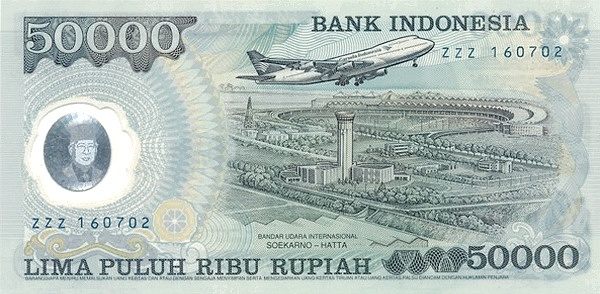
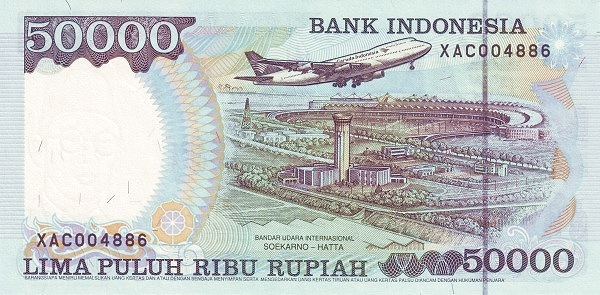
The paper versions, issued in 1993 and 1994 and printed by Perum Percetakan Uang Republik Indonesia (Peruri), share a nearly identical design. On the front, the banknote features a dignified portrait of President Soeharto, surrounded by vignettes illustrating development achievements such as education, agriculture, industry, and national planning. The reverse highlights Soekarno–Hatta International Airport, symbolizing Indonesia’s growing global connectivity, with an aircraft soaring above as a marker of technological progress.
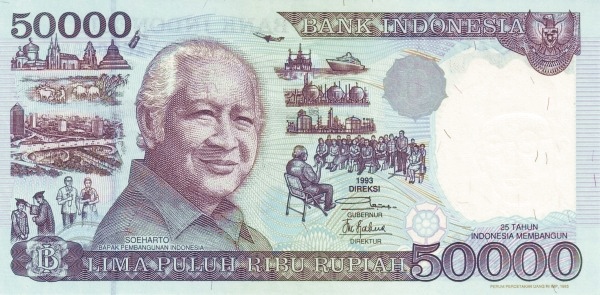
Both versions were issued with a face value of 50,000 Rupiah and circulated as legal tender. Today, these commemorative notes are highly regarded by collectors, not only for their historical significance but also for documenting Indonesia’s early transition toward advanced banknote materials. Together, the paper and polymer issues stand as a lasting monetary record of a defining developmental era in Indonesian history.