
Laos 100,000 Kip Commemorative Banknote 2010: Celebrating Vientiane’s 450 Years and the Lao PDR’s National Journey
The Laos 100,000 kip commemorative banknote issued in 2010 is one of the most historically rich and symbolically layered banknotes ever released by the Bank of the Lao PDR. Introduced on 15 November 2010, the note commemorates two major national milestones: the 450th anniversary of Vientiane as the capital city and the 35th anniversary of the establishment of the Lao People’s Democratic Republic (Lao PDR). By combining dynastic heritage, revolutionary leadership, Buddhism, and national identity into a single design, this issue serves as both a monetary instrument and a visual narrative of Lao history.
At the time of issue, the 100,000 kip denomination—equivalent to approximately US$12.45—was the highest-value banknote in circulation, underscoring its commemorative importance. Printed by Goznak, the note measures 159 × 68 mm and is produced on high-quality paper with advanced security features.
Historical Context and Commemorative Purpose
Vientiane became the capital of the Lao kingdom in 1560 under the reign of King Setthathirat, a pivotal ruler who consolidated political power and established the city as the spiritual and administrative heart of Laos. Four and a half centuries later, the city remains the symbolic center of Lao sovereignty.
The second anniversary marked on the banknote—the 35th anniversary of the Lao PDR in 2010—commemorates the founding of the modern socialist state in 1975. By pairing these two anniversaries, the banknote bridges pre-modern monarchy and modern revolutionary governance, presenting Lao history as a continuous, unified national journey rather than a series of ruptures.
Obverse: Kingship, Spiritual Guardianship, and National Identity
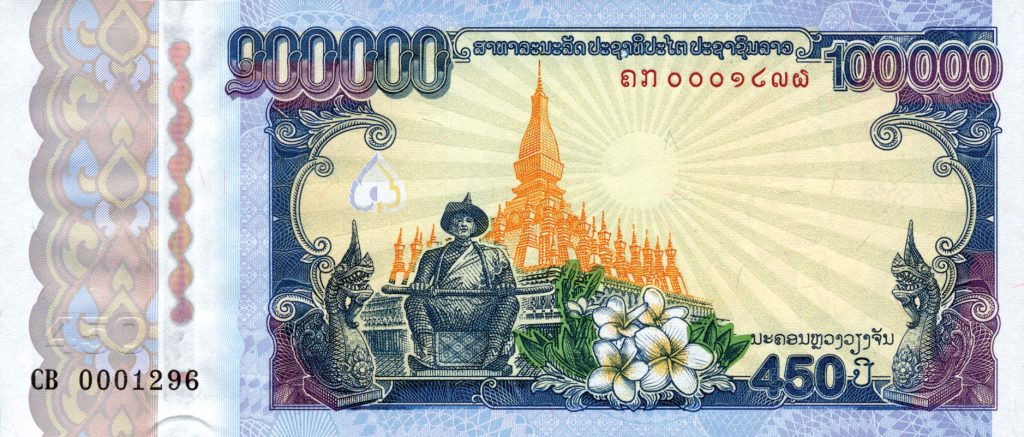
The obverse of the banknote is dominated by imagery that emphasizes royal legitimacy, Buddhism, and protection. At the center is a statue of King Setthathirat, shown seated in a dignified pose, representing strong leadership and the historical foundations of the Lao nation. His image recalls his role in relocating the capital to Vientiane and defending the kingdom against external threats.
Behind the king rises Wat That Luang, the most sacred Buddhist monument in Laos and a powerful national symbol. The stupa is rendered in warm gold tones, radiating against a sunburst background that signifies enlightenment, continuity, and the enduring spiritual core of Lao society.
Flanking the composition are naga serpents, mythical beings deeply rooted in Lao and Mekong River cosmology. The naga symbolize protection, fertility, and the life-giving power of water, reinforcing the idea of divine guardianship over the nation. Completing the obverse design are frangipani flowers—the national flower of Laos—representing peace, hospitality, and cultural grace.
Reverse: Cultural Heritage and Religious Continuity
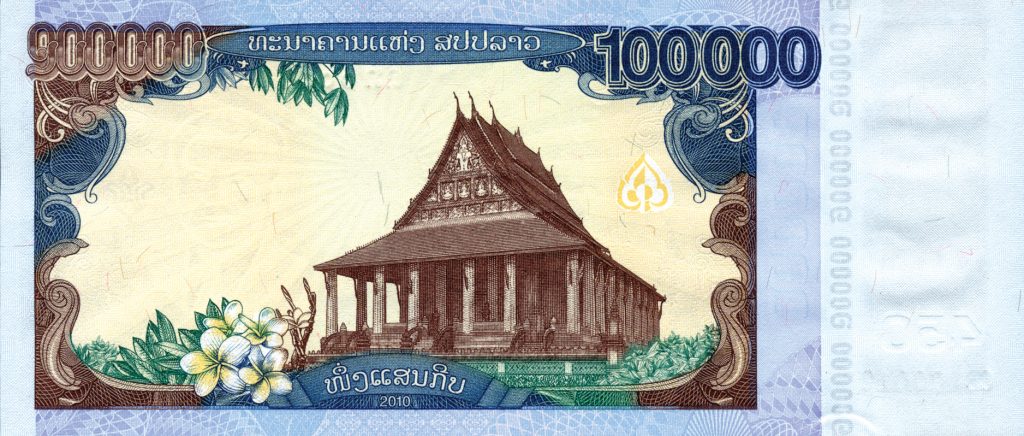
The reverse side shifts the focus from statehood to cultural and religious heritage. At its center is Ho Phra Keo, a historic temple in Vientiane that once housed the Emerald Buddha. The temple symbolizes the intersection of monarchy, Buddhism, and national identity, even though the Emerald Buddha now resides outside Laos.
Surrounding the temple are frangipani blossoms and traditional decorative motifs, reinforcing themes of cultural continuity and aesthetic harmony. The reverse design underscores that Laos’s national identity is inseparable from its religious architecture and artistic traditions.
Security Features and Technical Design
The note incorporates modern security technology consistent with its high denomination. A holographic security thread printed with demetalized Lao denomination numerals runs vertically through the note, providing visual movement and anti-counterfeiting protection. The watermark features Kaysone Phomvihane, the founding leader of the Lao PDR and a central figure in the country’s modern political history. His presence as a watermark subtly balances the royal imagery on the obverse, reinforcing the dual historical narrative of monarchy and revolutionary leadership.
The predominant color scheme—blue, gold, green, and brown—evokes stability, prosperity, nature, and tradition. Lao text dominates both sides, emphasizing national language and sovereignty, while numerals remain clear and accessible for everyday use.
Symbolic and Numismatic Significance
What makes the 2010 Laos 100,000 kip commemorative note especially significant is its integrative symbolism. Few banknotes so explicitly unite ancient kingship, Buddhist spirituality, socialist statehood, and cultural heritage within a single coherent design. The juxtaposition of King Setthathirat and Kaysone Phomvihane visually narrates Laos’s transformation across centuries while asserting continuity rather than conflict between eras.
As a circulating commemorative issue, the note carried its historical message into daily economic life, allowing ordinary citizens to engage with national memory through routine transactions. For collectors, it stands as one of the most important Lao banknotes of the modern era, valued for its artistry, historical depth, and commemorative purpose.
In essence, the Laos 100,000 kip commemorative banknote of 2010 is far more than currency. It is a carefully crafted statement of identity—honoring Vientiane’s centuries-old legacy, acknowledging the foundations of the Lao PDR, and affirming the enduring cultural and spiritual pillars of the Lao nation.