

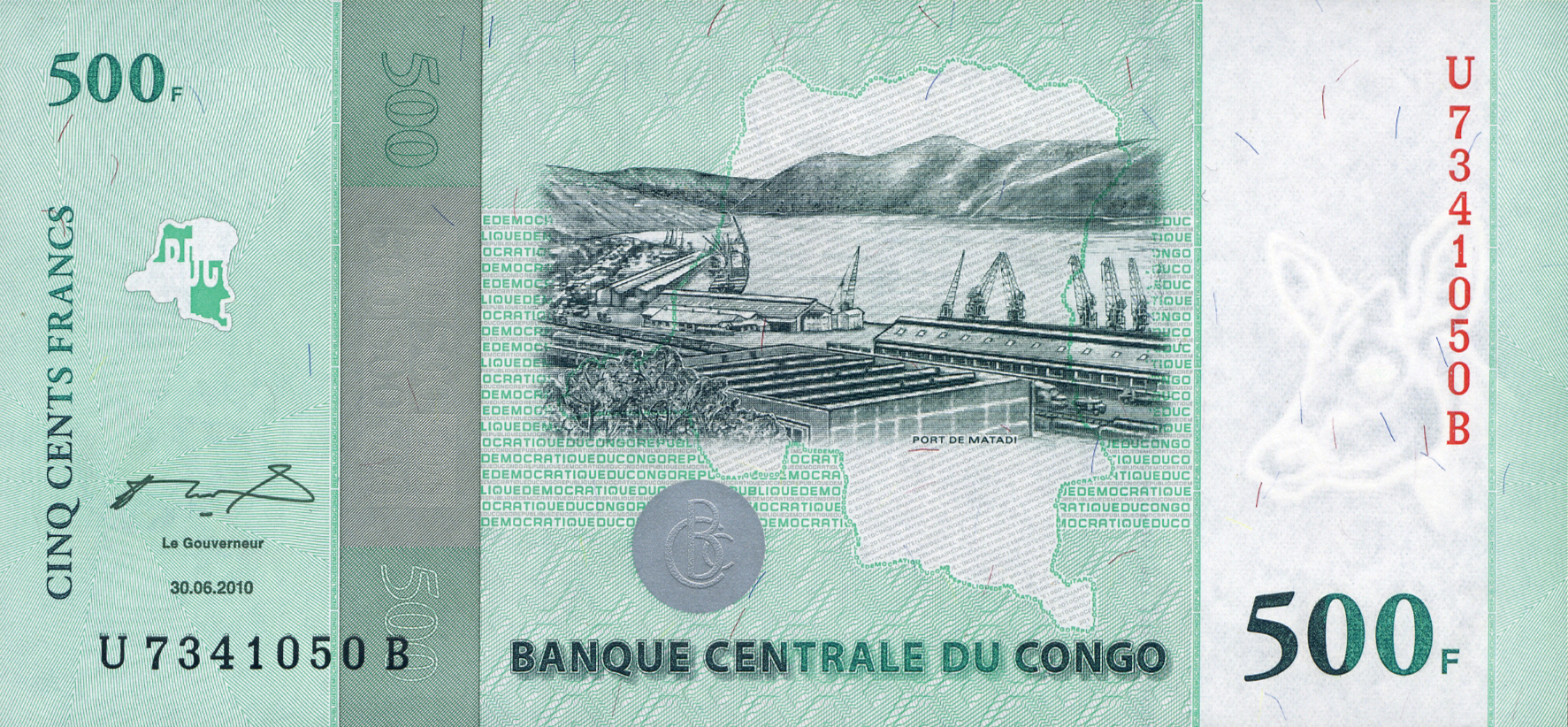
The 2010 DR Congo 500 Francs Commemorative Banknote
A Scholarly and Artistic Study of Design, Printing Technology, and Historical Meaning
1. General Description of the Banknote
The 500 francs commemorative banknote of the Democratic Republic of the Congo (DRC), issued in 2010, represents a carefully conceived blend of monetary function, national memory, and graphic art. The note was released by the Banque Centrale du Congo to mark the 50th anniversary of independence (1960–2010) of the Democratic Republic of the Congo from Belgium.
Unlike many commemorative banknotes that are issued solely for collectors, this note was produced in a substantial quantity—approximately 20 million pieces—and entered general circulation, circulating alongside regular 500-franc notes. This decision underscores its dual nature: both a legal tender for daily transactions and a commemorative object carrying historical significance.
The color palette is dominated by soft green, blue, and grey tones, evoking water, land, and infrastructure—recurring themes in the visual narrative of the note.
2. Obverse: Industry, Territory, and Economic Aspiration
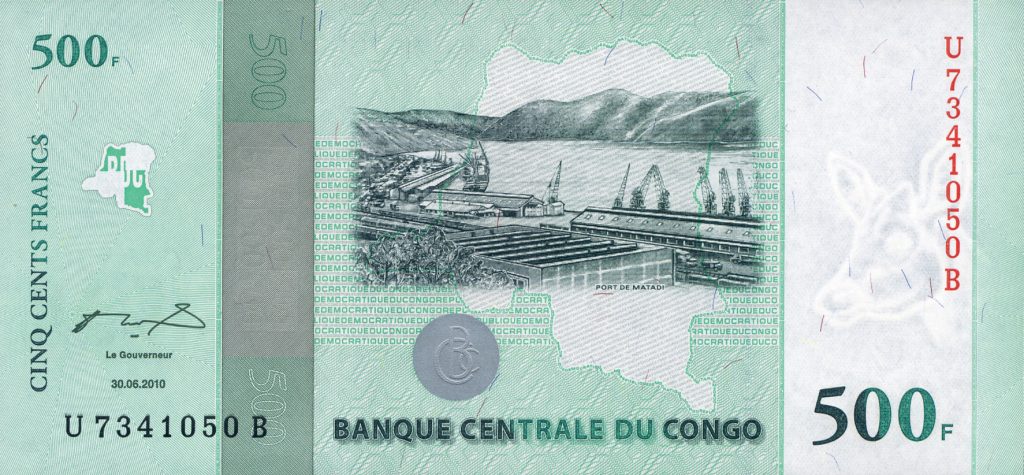
The obverse design centers on an engraved depiction of Port of Matadi, the country’s principal maritime port and a strategic gateway to international trade. The port complex is shown with warehouses, cranes, and riverine infrastructure, framed within the outline of the national territory.
Matadi holds deep symbolic weight in Congolese history. During the colonial period, it was a key node in the extraction and export of resources. In the post-independence era, it came to represent economic continuity and the hope for sovereign development. By placing Matadi at the center of the obverse, the designers emphasized productive capacity, connectivity, and modernization rather than individual political figures.
Typography and layout are restrained and formal. The issuing authority’s name, BANQUE CENTRALE DU CONGO, appears prominently, reinforcing institutional legitimacy. The serial numbering, security elements, and denomination are integrated seamlessly into the composition, preserving clarity while maintaining visual balance.
3. Reverse: Infrastructure, Unity, and National Continuity
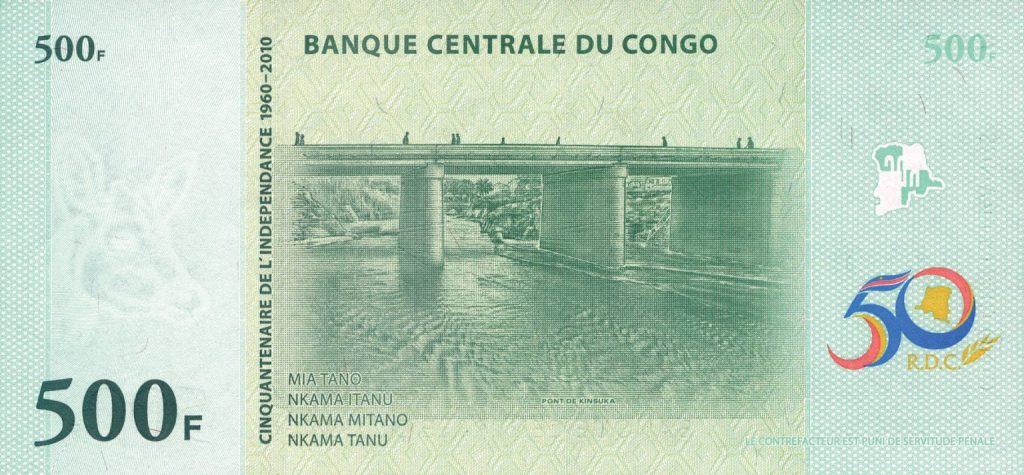
The reverse features a finely detailed image of the Kinsuka Bridge, spanning the Congo River. Above the scene runs the inscription “CINQUANTENAIRE DE L’INDÉPENDANCE 1960–2010”, explicitly anchoring the banknote to its commemorative purpose.
Bridges have long served as metaphors in political iconography, and here the symbolism is clear. The Kinsuka Bridge represents connection, national integration, and reconstruction, themes particularly resonant in a country marked by vast geography and decades of internal conflict. The image suggests continuity across time—linking the colonial past, the moment of independence, and aspirations for a stable future.
The commemorative logo marking the 50th anniversary appears on the reverse, rendered in a modern graphic style that contrasts intentionally with the traditional engraved aesthetic of the bridge. This juxtaposition reflects Congo’s negotiation between heritage and modern statehood.
4. Printing Technology and Security Features
From a technical perspective, the 2010 500 francs commemorative demonstrates the application of modern banknote printing standards. It was produced using a combination of offset printing and intaglio engraving, ensuring both visual depth and tactile security.
Key security features include:
-
Watermarks, incorporating abstract portrait and territorial motifs
-
Embedded security thread within the paper
-
Microtext legible only under magnification
-
Fluorescent fibers visible under ultraviolet light
The paper substrate is designed for durability, an essential consideration given the heavy circulation conditions typical in Central Africa. The inclusion of advanced security features on a commemorative circulating note signals the central bank’s intention to strengthen public confidence in the national currency.
5. Historical Context and Commemorative Significance
Congo’s independence on 30 June 1960 marked the end of Belgian colonial rule but also the beginning of prolonged instability, including political crises, secessionist movements, authoritarian rule, and regional wars. By 2010, the country sought to reframe its national narrative—not as a story defined solely by turmoil, but as one of endurance and continuity.
The issuance of this banknote was part of a broader program of symbolic acts commemorating independence. Notably, the design avoids portraits of political leaders. Instead, it highlights collective achievements and structural foundations—ports, bridges, and territory—suggesting a deliberate effort to emphasize the nation rather than personalities.
This design choice aligns with a post-conflict ethos that prioritizes unity and shared infrastructure as the basis of state legitimacy.
6. Numismatic and Research Value
For numismatists and researchers, the 2010 DR Congo 500 francs commemorative note is significant for several reasons:
-
It is a circulating commemorative, not limited to collectors
-
It documents a major national milestone through visual language
-
It reflects post-colonial design philosophy in African banknote art
As a research object, the note offers insight into how monetary instruments can function simultaneously as economic tools, historical documents, and works of graphic design.