

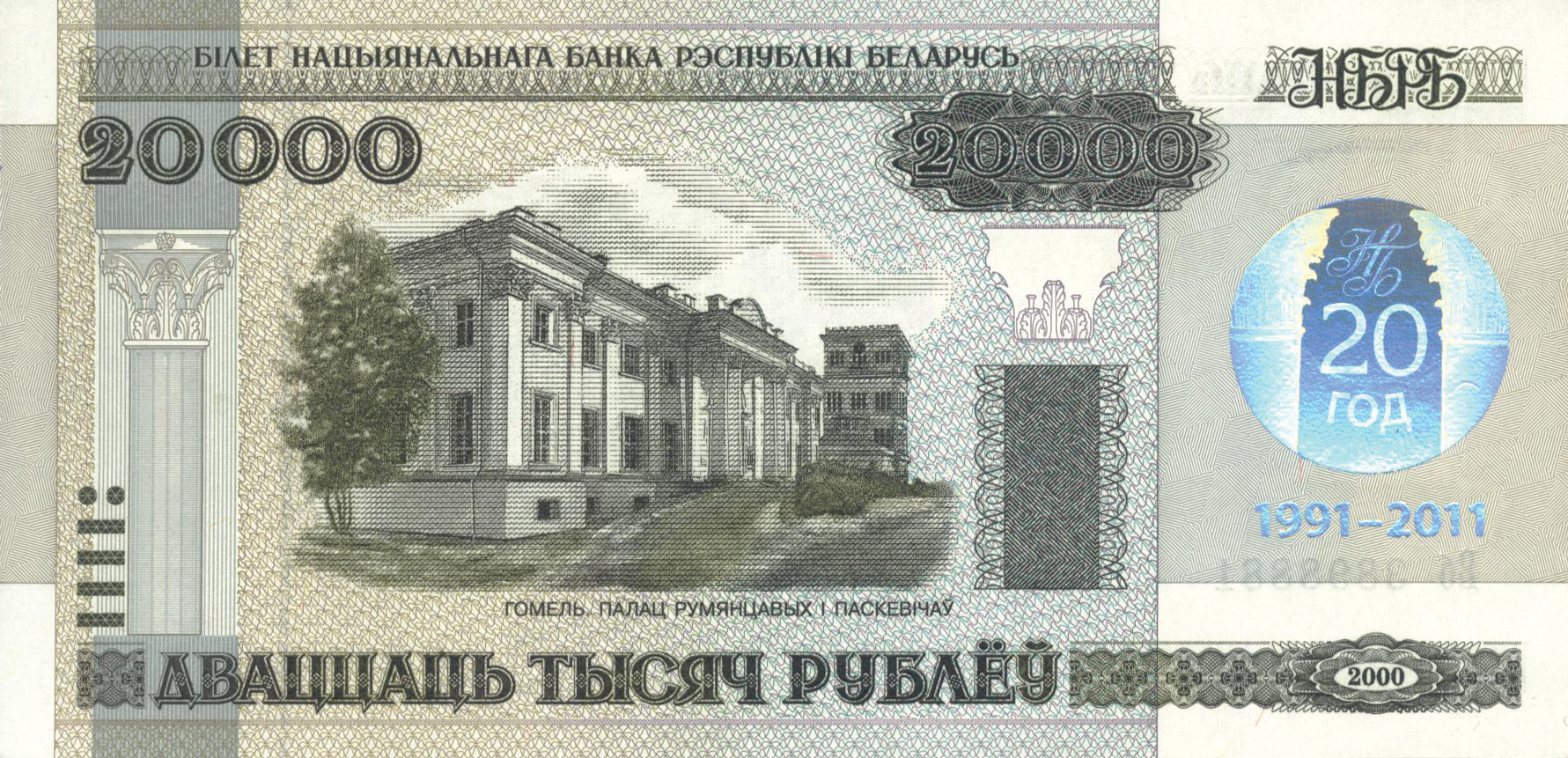
The 2011 Belarus 20,000-Ruble Commemorative Banknote
The commemorative note is structurally based on the 20,000-ruble denomination first introduced in 2000 (catalogue B131). By adopting an existing and well-recognized design framework, the National Bank emphasized institutional continuity while introducing targeted symbolic and technological enhancements that distinguish the commemorative issue from its predecessor.
The 2011 Belarus 20,000-Ruble Commemorative Banknote:
Design Continuity, Printing Technology, and Institutional Memory
The 2011 20,000-ruble commemorative banknote of Belarus was issued by the National Bank of the Republic of Belarus to mark the 20th anniversary of the modern National Bank (1991–2011). According to the official press release dated 18 November 2010, the note entered issue on 1 December 2011 in a strictly limited collector format of 3,000 examples, each presented in a special booklet. Although legally connected to the circulating monetary system, this issue was conceived primarily as a numismatic and documentary artifact rather than a mass-circulation medium.
Visual Description and Artistic Composition
The obverse of the note preserves the architectural theme characteristic of Belarusian banknotes of the late 1990s and early 2000s. Dominating the composition is an engraved depiction of the Rumyansev-Paskevich Palace in Gomel, an important neoclassical landmark associated with the cultural and administrative history of the region. The palace is rendered in finely structured line engraving, combining depth, perspective, and tonal variation to convey both monumentality and refinement.
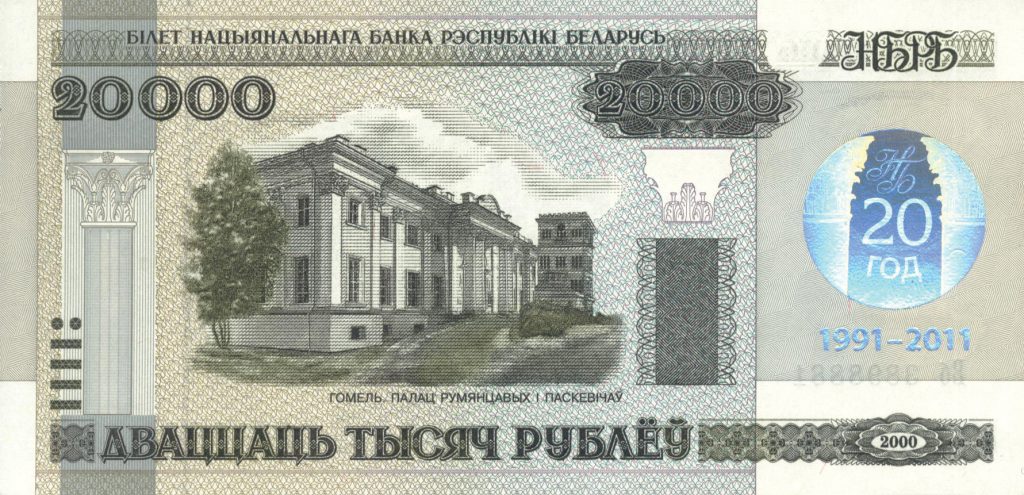
The surrounding design elements—ornamental frames, classical columns, and guilloché patterns—reflect a deliberate neoclassical aesthetic. These motifs visually align the note with European banknote traditions, emphasizing order, permanence, and institutional authority. Denomination numerals (“20000”) appear prominently in multiple locations, integrated into cartouches and ornamental fields to reinforce legibility and hierarchy.
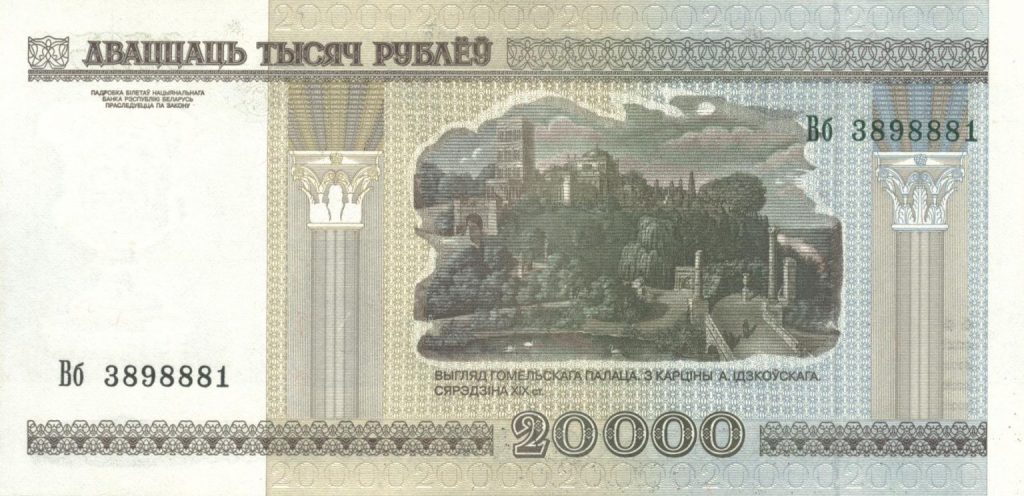
The reverse continues the architectural narrative with a complementary vignette related to the Gomel palace ensemble, framed by dense ornamental borders and layered background textures. The balanced symmetry between obverse and reverse reflects a conservative design philosophy that prioritizes clarity, harmony, and historical reference over dramatic visual experimentation.
The most significant visual addition distinguishing the commemorative from the standard issue is the application of a holographic element over the watermark area, bearing the inscription “NB 1920 1991–2011.” This feature functions simultaneously as a security device and a commemorative emblem, explicitly anchoring the note within a centennial narrative of Belarusian central banking.
Printing Technology and Security Features
From a technical perspective, the 2011 commemorative 20,000-ruble note demonstrates a sophisticated integration of traditional intaglio printing with modern security technologies. The primary imagery—architectural vignettes, denomination numerals, and ornamental frames—was produced using intaglio engraving, providing tactile relief and sharp line definition. This technique not only enhances aesthetic quality but also serves as a critical anti-counterfeiting measure.
Offset lithography was employed for background coloration and fine repetitive patterns, enabling complex multi-layered designs that are difficult to replicate. Microtext elements, intricate guilloché networks, and precise line intersections further strengthen the note’s security profile.
The defining technological innovation of the commemorative issue is the hologram applied above the watermark, a feature absent from the original 2000 series. The hologram incorporates alphanumeric and date elements referencing the National Bank’s institutional timeline, including the symbolic year 1920, which alludes to earlier historical roots of Belarusian financial administration, alongside 1991–2011, marking the modern bank’s lifespan. This combination of optical security and historical inscription elevates the note from a standard security document to a layered historical artifact.
Symbolic Meaning and Numismatic Significance
The symbolic program of the 2011 commemorative note operates through restraint rather than visual excess. By maintaining the established design of the 2000 issue, the National Bank signaled stability and continuity in monetary authority. The introduction of a hologram, rather than a complete redesign, reflects a philosophy of incremental commemoration, where institutional memory is embedded into an existing visual language.
The Rumyansev-Paskevich Palace serves as more than an architectural subject. As a historic seat of power, culture, and governance, it symbolizes continuity between Belarus’s pre-modern, imperial, Soviet, and post-Soviet identities. Its presence on a commemorative note dedicated to the National Bank underscores the idea that financial institutions are inheritors and custodians of historical statehood.
The limited print run—only 3,000 notes—further reinforces the symbolic nature of the issue. Scarcity transforms the note into a curated object intended for preservation, study, and reflection rather than circulation. In this context, the banknote functions as a material archive, condensing architecture, technology, and institutional narrative into a single object.
Historical Background: Central Banking in Belarus
The National Bank of the Republic of Belarus was established in 1991 following the dissolution of the Soviet Union, assuming responsibility for monetary policy, currency issuance, and financial regulation in a newly independent state. Its formation marked a critical step in asserting economic sovereignty and redefining national identity in the post-Soviet landscape.
The reference to 1920 within the hologram inscription situates the modern institution within a longer historical continuum, acknowledging earlier forms of banking administration in Belarusian territory during the early twentieth century. This dual temporal framing—1920 and 1991–2011—allows the commemorative note to bridge pre-independence history with contemporary statehood.
Context and Collector Perspective
Issued at a time when Belarus was consolidating its monetary framework amid regional economic pressures, the 2011 commemorative note reflects both introspection and assertion. It looks inward, celebrating institutional endurance, while outwardly projecting technical competence and historical legitimacy.
For collectors and researchers, the note is valued not for artistic novelty alone, but for its documentary precision. The clear lineage to the 2000 issue, the explicit anniversary inscription, and the controlled print quantity make it a key reference point in the study of post-Soviet commemorative currency.
Conclusion
The 2011 Belarus 20,000-ruble commemorative banknote stands as a measured and intellectually coherent example of numismatic commemoration. Through continuity of design, selective technological enhancement, and carefully encoded symbolism, the National Bank of the Republic of Belarus transformed an existing banknote into a durable historical statement. For scholars and collectors alike, it represents a convergence of art, security printing, and institutional memory—captured in paper, ink, and light.