
The 2011 Kazakhstan 2,000-Tenge Commemorative Banknote
The 2011 Kazakhstan 2,000-Tenge Commemorative Banknote:
Sport, State Identity, and Advanced Security Printing
The 2011 2,000-tenge commemorative banknote of Kazakhstan was issued on 17 January 2011 by the National Bank of Kazakhstan to commemorate the 7th Asian Winter Games, hosted jointly by Astana and Almaty from 30 January to 6 February 2011. Unlike many commemorative banknotes that rely primarily on textual inscriptions or symbolic emblems, this issue represents a highly integrated synthesis of sport, national geography, and contemporary banknote technology. It stands as both a circulating monetary instrument and a carefully curated visual narrative of Kazakhstan’s modern statehood and international aspirations.
Visual Description and Artistic Composition
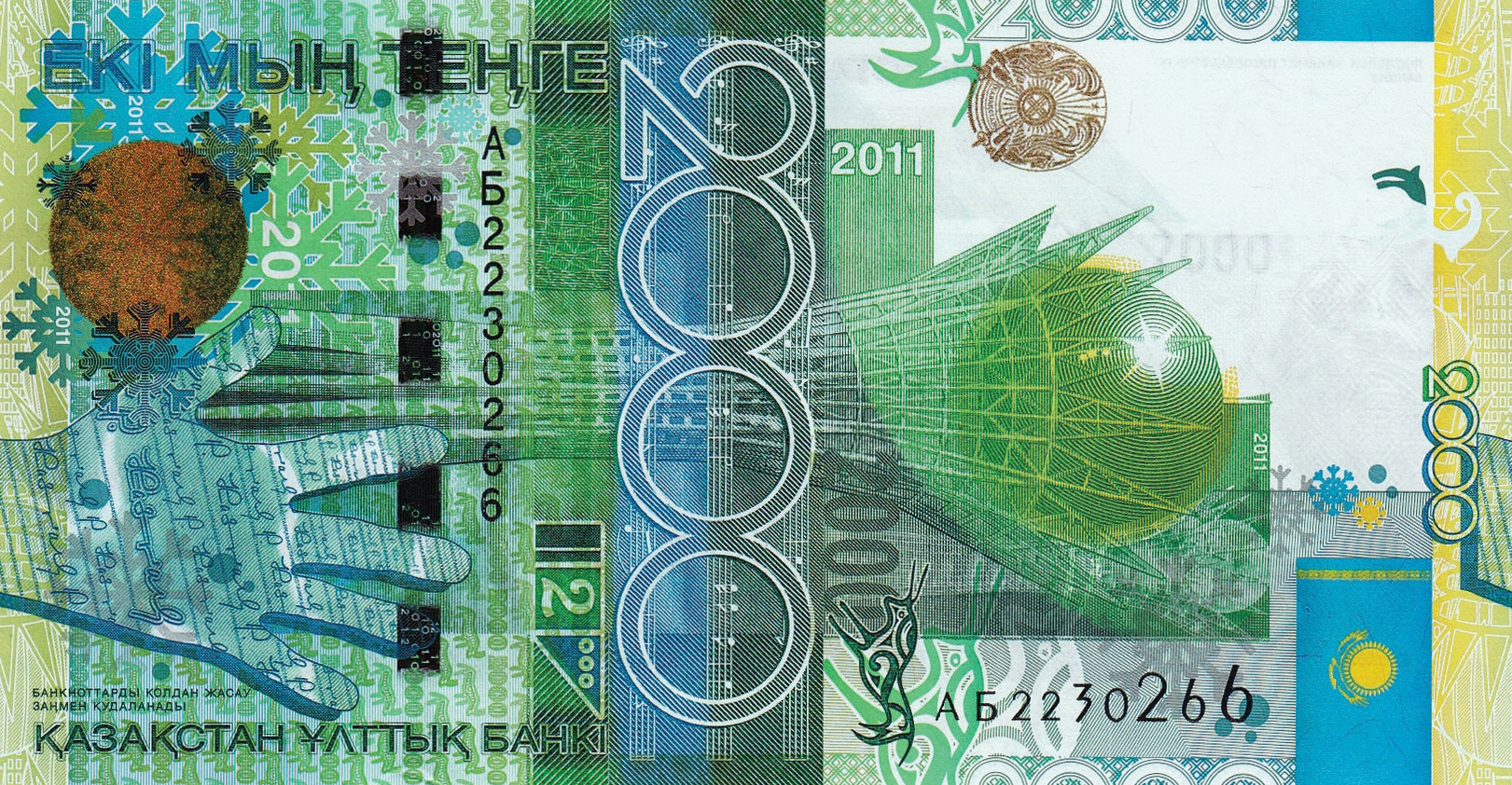
The banknote measures 139 × 73 mm and is printed on paper in a dominant palette of green and blue, colors commonly associated with winter landscapes, altitude, and vitality. The obverse is vertically oriented, a defining characteristic of Kazakhstan’s modern banknote series, which emphasizes dynamism and modernity over classical horizontal layouts.
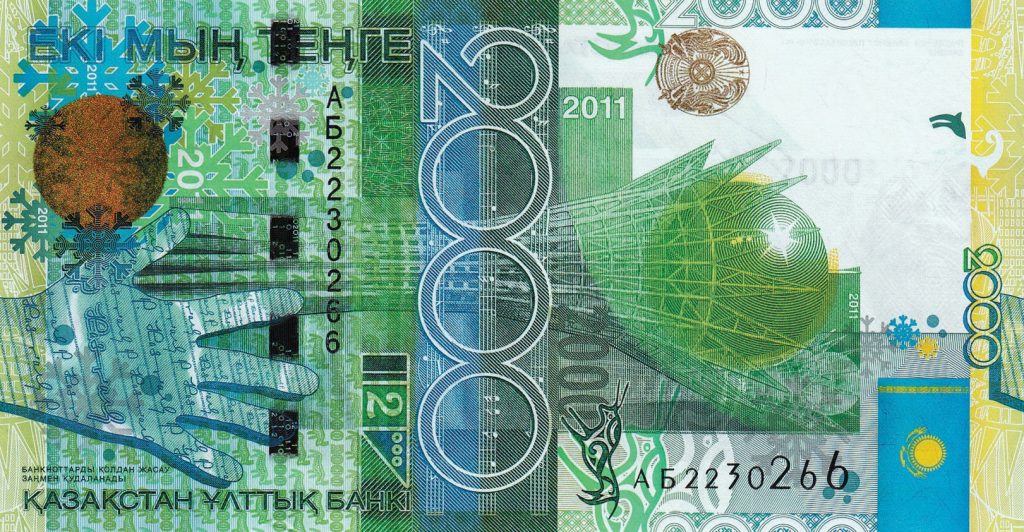
The front design is dense yet highly structured. Prominent among its motifs is the Baiterek Monument, an architectural symbol of Astana and a visual shorthand for post-independence nation-building. Surrounding this central motif are layers of national symbolism: the Kazakh national emblem, elements of the national flag, stylized palms, and fragments of sheet music that subtly reference cultural harmony and ceremonial identity. A field of gold-to-green Spark™ snowflakes animates the surface, reinforcing the winter sports theme while adding optical depth.
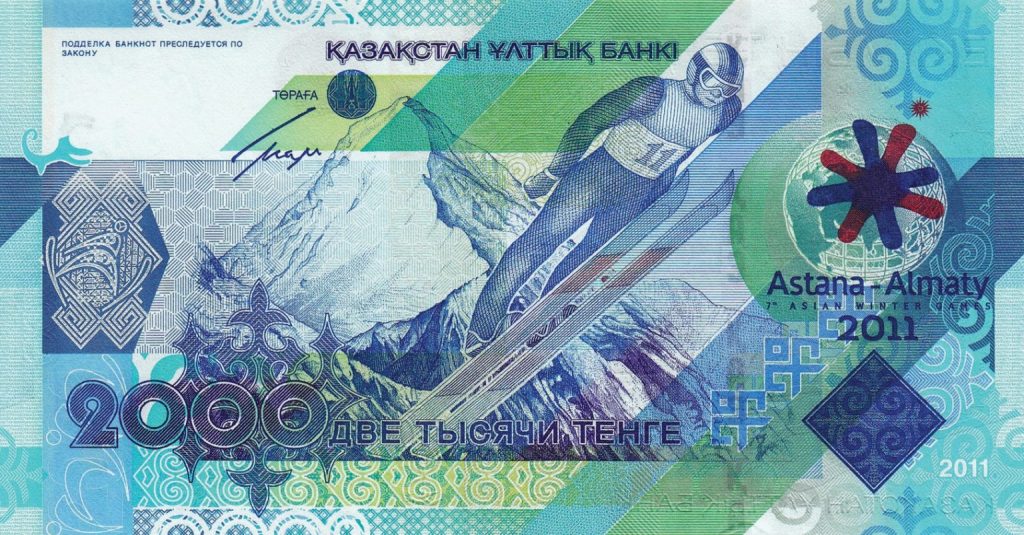
The reverse of the note presents a powerful alpine composition dominated by Khan Tengri, the iconic peak of the Tien Shan mountain range, rendered in fine engraved lines. In the foreground, a ski jumper in mid-flight captures a moment of athletic suspension, visually echoing both physical elevation and aspirational movement. Adjacent to this figure appears the globe emblem of the 7th Asian Winter Games, anchoring the composition in its commemorative purpose. The integration of landscape and athlete situates sport within the broader geography and identity of Kazakhstan, rather than isolating it as a purely competitive event.
Printing Technology and Security Features
Technologically, the 2011 2,000-tenge note represents one of the most advanced banknote productions of its time. The note combines intaglio printing for tactile relief and fine line precision with offset lithography for complex color transitions and background textures. This layered approach allows for both visual richness and robust anti-counterfeiting protection.
A key security element is the 4-mm wide StarChrome™ windowed security thread, which shifts from purple to green depending on the viewing angle. The thread is demetalized with the words “ASTANA ALMATY”, each character ingeniously formed from the digits 2011, merging security technology with commemorative symbolism. In addition, a solid embedded security thread runs through the paper, providing a secondary line of defense.
The watermark depicts a snow leopard, a powerful national symbol associated with strength, agility, and the high mountains of Central Asia, accompanied by an electrotype “2000.” Microprinting, precise registration, and complex geometric patterns further enhance security. The overall production was executed by the Banknote Factory of the National Bank of Kazakhstan (BFoNBK), reflecting the country’s growing technical self-sufficiency in high-security printing.
Symbolic Meaning and Cultural Interpretation
The symbolic program of the banknote operates on several interconnected levels. At its core, it celebrates Kazakhstan’s role as host of a major continental sporting event, signaling the country’s integration into Asian and global sporting networks. However, the imagery extends beyond sport to articulate a broader narrative of modern state identity.
The juxtaposition of Baiterek on the obverse and Khan Tengri on the reverse creates a symbolic axis between urban modernity and natural grandeur. This duality reflects Kazakhstan’s self-presentation as a technologically advancing state rooted in vast landscapes and deep historical geography. The ski jumper, suspended against the mountain backdrop, functions as a metaphor for aspiration, progress, and disciplined excellence—qualities the state seeks to project internationally.
Historical Context: Sport and Nation-Building
Since gaining independence in 1991, Kazakhstan has used large-scale international events as instruments of soft power and national branding. Hosting the 7th Asian Winter Games was a strategic milestone, demonstrating organizational capacity, infrastructure development, and regional leadership. The issuance of a commemorative banknote aligns with this strategy, embedding the event into everyday economic life and collective memory.
The 2,000-tenge denomination itself occupies a middle position in Kazakhstan’s currency system, making it suitable for wide circulation while still allowing for elaborate design. This balance ensures that the commemorative message reached a broad domestic audience rather than remaining confined to collectors.
Numismatic Context and Collector Significance
From a numismatic perspective, the 2011 Asian Winter Games banknote is notable for its integration of cutting-edge security technology with contemporary graphic design. It represents a mature phase in Kazakhstan’s post-independence currency development, moving beyond transitional aesthetics toward a confident and distinctive national style.
Collectors value the note for its thematic coherence, technical sophistication, and clear historical anchoring. Unlike limited-edition booklet issues, this note circulated broadly, making high-grade examples particularly desirable. For researchers, it serves as a case study in how modern states employ banknote design as a medium of cultural diplomacy.
Conclusion
The 2011 Kazakhstan 2,000-tenge commemorative banknote stands as a compelling example of how currency can function simultaneously as money, art, and historical document. Through its dynamic imagery, advanced printing technologies, and layered symbolism, the National Bank of Kazakhstan transformed a sporting commemoration into a durable expression of national identity. For collectors and scholars alike, the note offers a richly textured window into Kazakhstan’s ambitions, geography, and technological capabilities at the beginning of the second decade of the 21st century.