

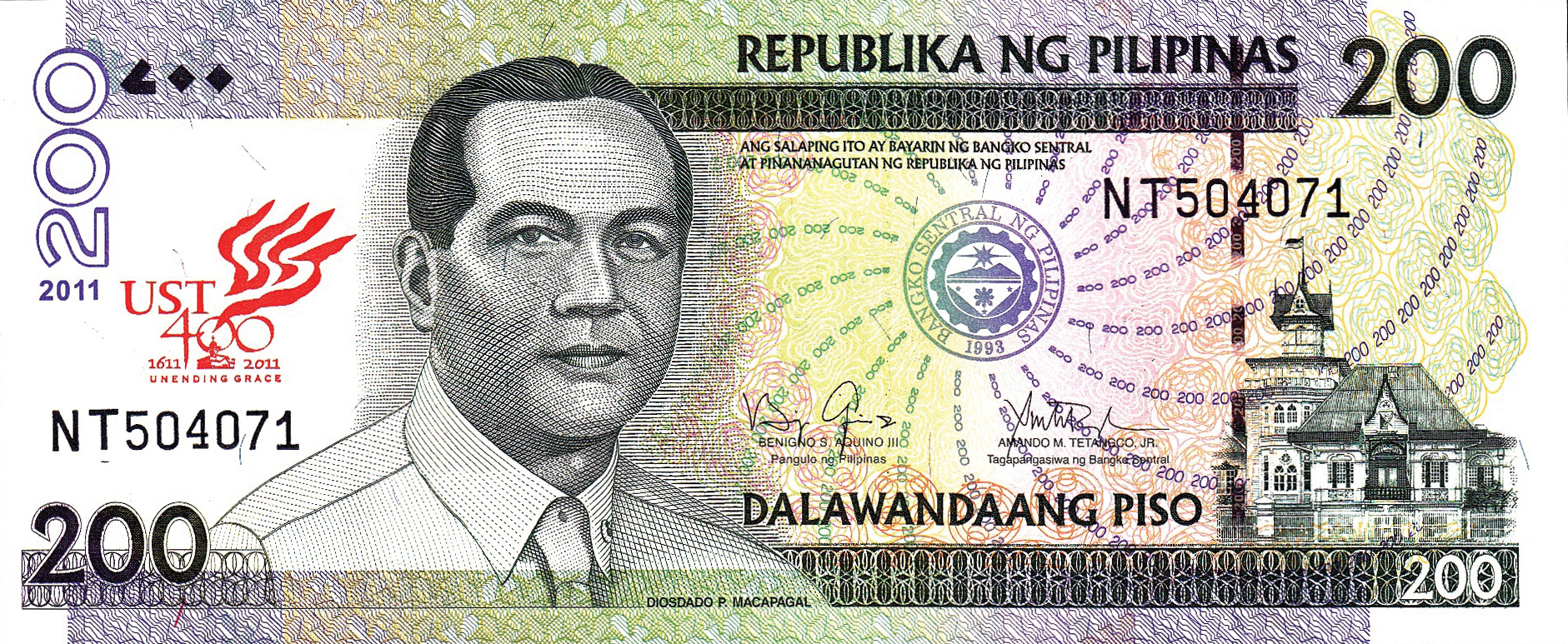
The 2011 Philippine 200-Peso University of Santo Tomas Quadricentennial Banknote
The 2011 Philippine 200-Peso University of Santo Tomas Quadricentennial Banknote
Memory, Authority, and Commemoration in a Circulating Currency
In 2011, the Bangko Sentral ng Pilipinas issued a distinctive 200-peso commemorative banknote to mark the 400th anniversary of the University of Santo Tomas (UST)—the oldest continuously operating university in Asia. Unlike limited-edition commemoratives intended solely for collectors, this issue was produced in 10 million legal-tender notes, embedding an academic milestone into the daily monetary life of the nation. The note is catalogued as B1065 (P212C) and is based on the “old style” 200-peso design (Pick 195), later demonetized on 30 June 2017. Its significance lies not only in what it celebrates, but in how it juxtaposes education, political memory, and state authority within a single circulating object.
Visual Description and Artistic Structure
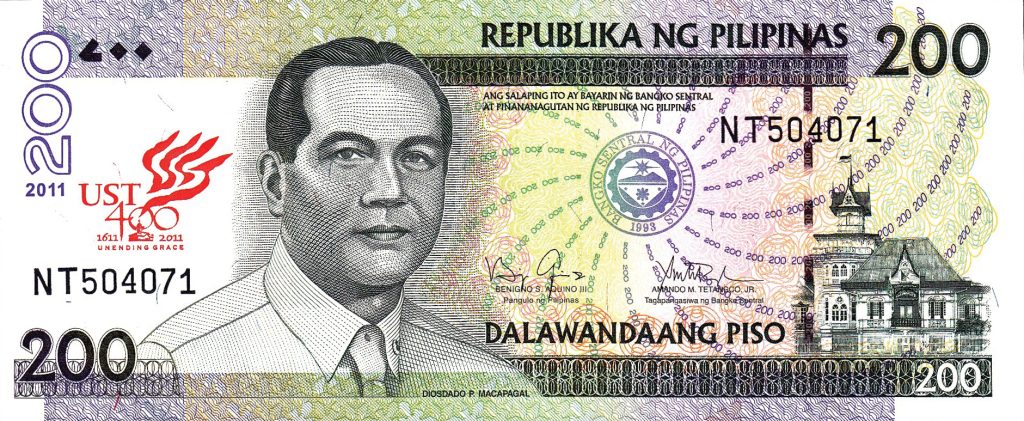
Measuring 160 × 66 mm and printed on paper, the banknote adopts a green, violet, and pink palette consistent with the 200-peso denomination. The obverse retains the portrait of Diosdado P. Macapagal, rendered in intaglio with fine line density and tonal modeling. To the right appears the Bangko Sentral ng Pilipinas seal, while the Aguinaldo Shrine in Kawit, Cavite—a locus of Philippine independence—anchors the architectural narrative.
What distinguishes the commemorative is the overprint on the watermark area: a vivid UST Quadricentennial emblem composed of tongues of fire forming the letters U, S, and T, accompanied by the inscription “UST 1611–2011 UNENDING GRACE” in red. The flames emanate symbolically from the university’s Main Building, visually asserting continuity between faith, scholarship, and national formation. The overprint is deliberately restrained in scale yet emphatic in color, ensuring legibility without overwhelming the base design.
The reverse presents a historically charged tableau: Gloria Macapagal-Arroyo being sworn in as president in January 2001, her hand placed on a Bible held by Cecilia Paz Razon Abad, with Chief Justice Hilario Davide Jr. administering the oath. A dense crowd fills the background, banners raised, situating the scene within a moment of civic mobilization. The composition balances figural clarity with mass movement, a hallmark of narrative engraving adapted to banknote scale.

Printing Technology and Security Features
Technically, the note exemplifies late-20th/early-21st-century Philippine security printing. Intaglio is employed for the principal portrait and key inscriptions, delivering tactile relief and micro-precision. Offset lithography supports complex chromatic fields and guilloché textures, while letterpress elements ensure crisp typography.
Security features include a windowed security thread with demetalized “200” repeating along its length, paired with a solid embedded thread for redundancy. The watermark reprises the portrait of Diosdado Macapagal, harmonizing security with iconography. Microprinting, fine-line moiré, and accurate registration further harden the note against counterfeiting. The overprinted quadricentennial emblem, placed strategically in the watermark zone, doubles as an event marker and a subtle anti-copy element, since precise color placement over translucent fields is difficult to replicate.
Meaning and Symbolic Program
The symbolic program operates on three interlocking axes: education, political legitimacy, and state continuity. By honoring University of Santo Tomas, founded in 1611, the note foregrounds the Philippines’ deep educational heritage—one that predates the modern republic by centuries. The fiery emblem evokes Pentecostal imagery and intellectual illumination, aligning academic tradition with moral vocation.
Concurrently, the base design’s political scenes assert constitutional process and peaceful transition. The coexistence of a university anniversary with a pivotal oath-taking scene is not accidental; it frames education as a stabilizing force within democratic life. Currency here functions as civic pedagogy, reminding users that institutions—universities and courts alike—sustain the republic.
Historical Background and Context
UST’s quadricentennial unfolded amid a period of institutional reflection in Philippine society, where questions of governance, legitimacy, and reform remained salient. Issuing a mass-circulation commemorative—rather than a scarce collector piece—ensured broad public encounter with the anniversary narrative. In parallel, the BSP released gold and silver medals (non-monetary) and numismatic products such as uncut two-note sheets, creating a tiered commemorative ecosystem spanning everyday use and archival preservation.
The choice to employ the older 200-peso design underscores continuity. Rather than reimagine iconography wholesale, the BSP layered new meaning atop a familiar template—an approach that respects public recognition while enabling commemoration through selective intervention.
Numismatic Perspective and Legacy
For collectors, the note’s appeal lies in context and circulation. With 10 million notes issued, rarity is not the driver; instead, desirability stems from condition, completeness of overprint color, and provenance. The note’s demonetization in 2017 adds a temporal boundary, transforming it from daily instrument to historical artifact.
Scholarly interest centers on the banknote as a composite document: it records a university’s endurance, a state’s memory of constitutional transfer, and a central bank’s philosophy of commemorating culture through money. Few modern notes integrate academic celebration so directly into legal tender at scale.
Conclusion
The 2011 Philippine 200-peso UST Quadricentennial banknote demonstrates how currency can transcend exchange to become a medium of collective memory. Through layered imagery, robust security printing, and judicious overprinting, the Bangko Sentral ng Pilipinas embedded four centuries of scholarship into a note already dense with political meaning. As a result, the banknote stands as an eloquent synthesis of art, technology, and history—circulating proof that education, like money, underwrites the life of the nation.