
The Sultanate in Ink: An Artistic and Technological Study of Oman’s 20-Rial 40th National Day Commemorative Banknote
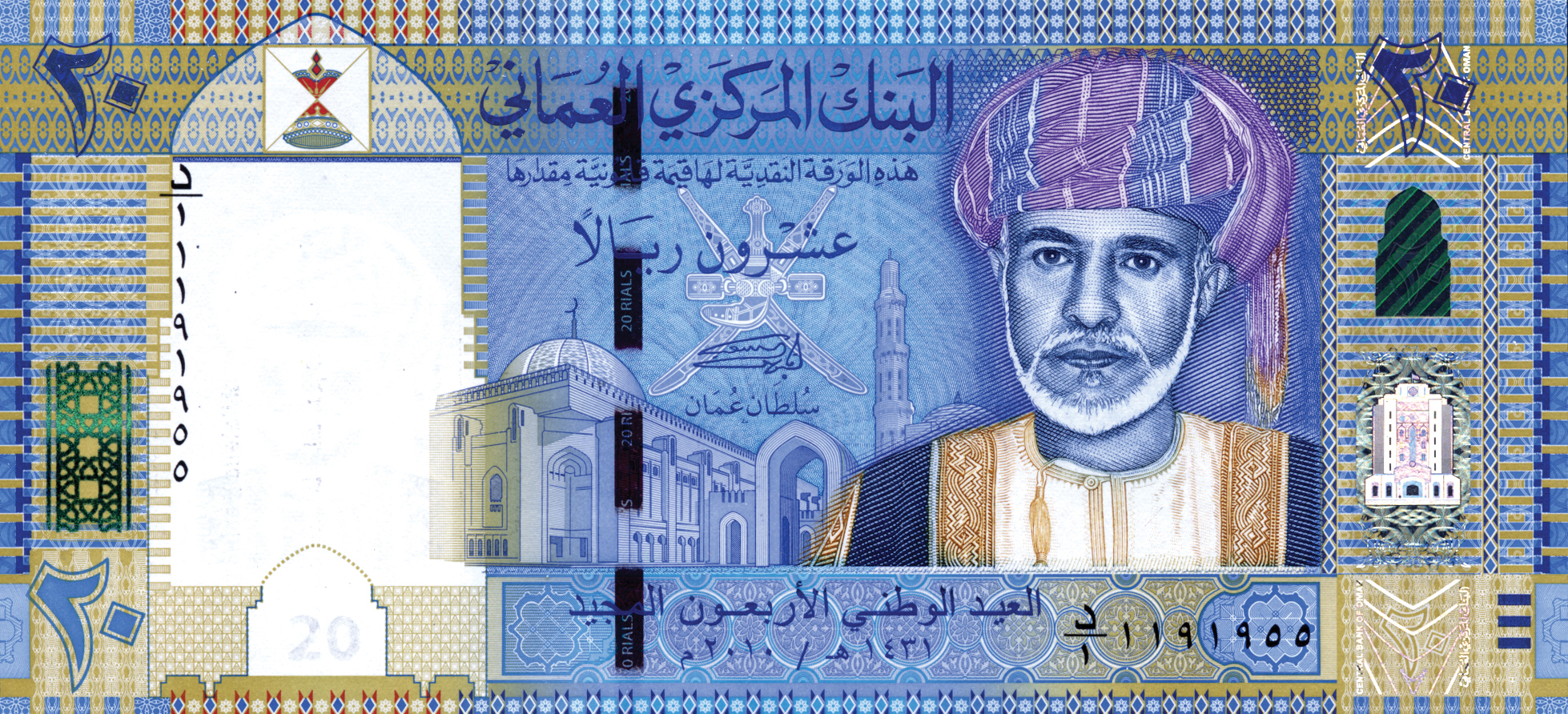
Issued by the Central Bank of Oman, the 20-rial commemorative banknote marking Oman’s 40th National Day (1431H / 2010) stands as one of the most refined expressions of modern Middle Eastern banknote design. Printed by Giesecke & Devrient, the note is not merely a monetary instrument but a carefully composed visual manifesto that fuses statehood, cultural continuity, and cutting-edge security engineering. Measuring 167 × 76 mm and printed on high-quality paper, the note belongs to a lineage of Omani currency renowned for aesthetic restraint, symbolic density, and technical sophistication.
Physical Description and Visual Composition
The dominant palette—blue, olive green, and violet-purple—evokes both maritime heritage and royal dignity, long associated with Oman’s geography and political identity. The obverse is anchored by a finely engraved portrait of Sultan Qaboos bin Said, depicted with calm authority and introspective restraint. Unlike heroic or militarized portrayals seen in other regions, this portrait emphasizes intellectual sovereignty and paternal guardianship, reflecting Sultan Qaboos’s role as the architect of modern Oman.
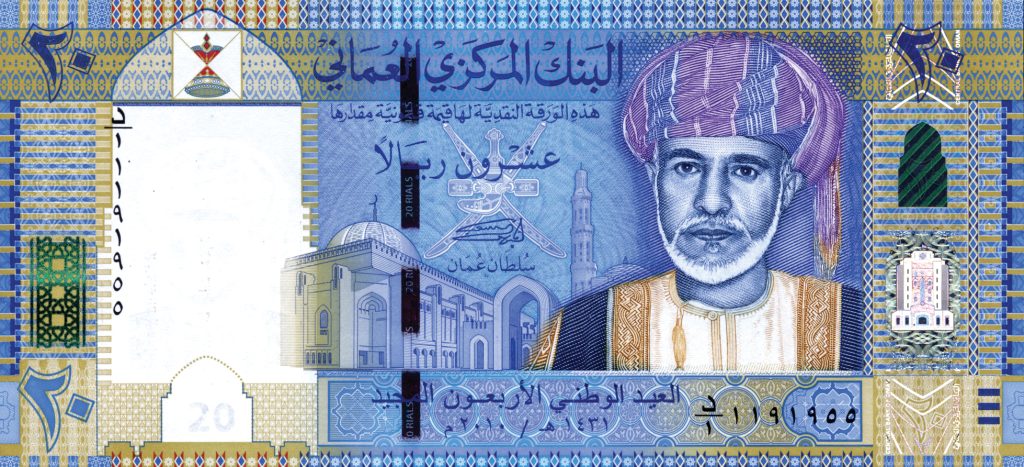
Behind the portrait appears the Sultan Qaboos Grand Mosque in Bausher, rendered in precise line engraving. Its architectural clarity—domes, arches, and minaret—functions as a visual metaphor for spiritual unity and national cohesion. Complementing this is the main entrance of the Central Bank of Oman headquarters, subtly reinforcing the institutional foundations of economic stability.
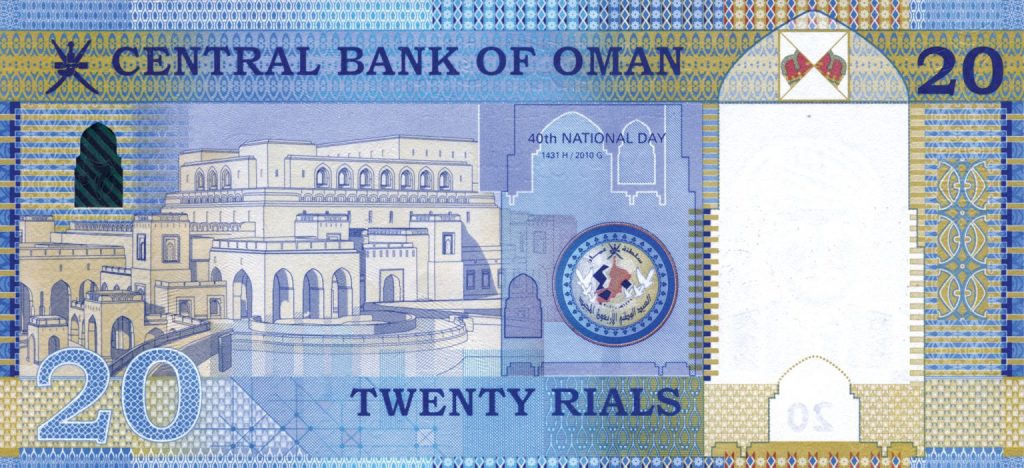
The reverse transitions into an outward-facing narrative of culture and global presence. The Royal Opera House Muscat—the first opera house in the Gulf—dominates the scene, symbolizing Oman’s investment in the arts, diplomacy, and cultural dialogue. Nearby, the 40th National Day emblem situates the note within a precise historical moment: four decades since Sultan Qaboos’s accession and the beginning of Oman’s modern renaissance.
Printing Technology and Security Architecture
From a technological standpoint, the note represents a high watermark of paper-based banknote security in the early 21st century. A Varifeye windowed security thread, demetalized with repeating “20 RIALS” inscriptions, shifts visually under light, combining movement and color change to deter counterfeiting. This is complemented by a multi-tone watermark portraying Sultan Qaboos alongside an electrotype “20,” ensuring both portrait integrity and denomination verification.
One of the most striking features is the green SPARK optically variable device, embedded on the obverse. This dynamic element changes brightness and hue when tilted, integrating seamlessly with the ornamental geometry rather than disrupting the aesthetic balance. Micro-lettering, fine guilloché patterns, latent images, and perfect registration crowns further reinforce the note’s security while maintaining visual harmony—an achievement that reflects G&D’s design philosophy of “security through beauty.”
Symbolism and National Meaning
Every element on the note participates in a layered symbolic system. The crossed swords and khanjar (dagger)—Oman’s coat of arms—assert continuity with pre-modern authority and tribal legitimacy, while their refined engraving situates them within a contemporary state framework. The mosque and opera house form a deliberate dialectic: faith and culture, tradition and modernity, introspection and outward engagement.
The bilingual layout—Arabic on the obverse, English on the reverse—further emphasizes Oman’s dual identity as a nation rooted in Arab-Islamic civilization yet fully engaged with the international system. This linguistic balance mirrors Sultan Qaboos’s foreign policy philosophy of neutrality, mediation, and cultural respect.
Historical Context and Commemorative Purpose
The year 2010 marked a pivotal juncture in Omani history. Forty years earlier, in 1970, Sultan Qaboos bin Said assumed power and initiated sweeping reforms that transformed Oman from an isolated polity into a stable, modern state with infrastructure, education, healthcare, and global diplomatic standing. The issuance of this banknote thus coincided not only with a national anniversary but with a broader reflection on modernization achieved without cultural rupture.
Unlike emergency or crisis-driven commemoratives, this note belongs to a category of affirmative state commemoration—celebrating continuity, legitimacy, and long-term vision. It circulated alongside standard 20-rial notes, reinforcing its role as both a functional currency and a mobile monument.
Numismatic Significance
For collectors and researchers, the Omani 20-rial 40th National Day note occupies a special position. It exemplifies the mature phase of paper-based security printing, just before polymer substrates became dominant globally. Its integration of advanced features without visual excess makes it a benchmark for evaluating later hybrid and polymer issues.
In sum, this banknote transcends its monetary value. It is a compressed archive of Omani statehood, where portraiture, architecture, technology, and ideology converge. As such, it stands not merely as a commemorative issue, but as a finely engraved historical document—one that allows scholars and collectors alike to read Oman’s modern identity through ink, paper, and light.